Flatten Nested List Iterator — Lazy Stack Design (LeetCode 341)
Design a Flatten Nested List Iterator using a stack for lazy flattening. Python solution with iterator protocol, step-by-step trace, and design analysis.
What you'll learn
- ✓How to flatten a nested list lazily with a stack
- ✓The NestedInteger interface and iterator protocol
- ✓Why reversed push preserves order
- ✓Complete Python implementation with trace
- ✓Trade-offs between eager and lazy flattening
Prerequisites
- •Stack basics — see Stacks Intro
- •Python iterators and the __iter__/__next__ protocol
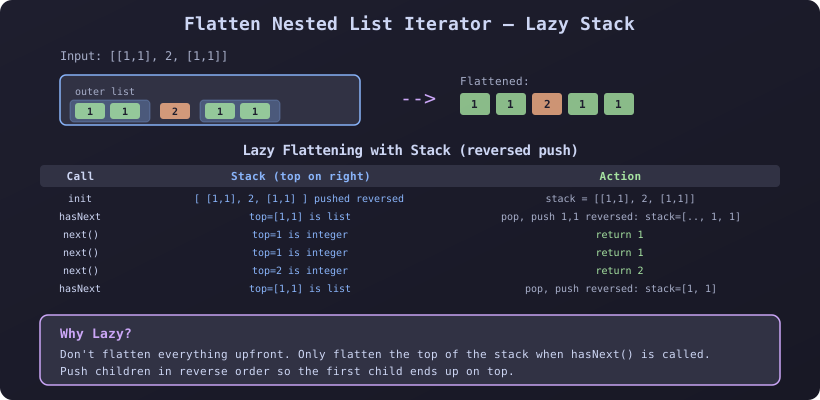
Flatten Nested List Iterator (LeetCode 341) is a design problem that combines stacks with the iterator pattern. The key insight is lazy flattening — you only expand nested lists when you actually need the next element.
The Problem
You are given a nested list of integers. Each element is either an integer or a list whose elements may also be integers or other lists. Implement an iterator to flatten it.
Input:  [[1,1], 2, [1,1]]
Output: [1, 1, 2, 1, 1]   (iteration order)

Input:  [1, [4, [6]]]
Output: [1, 4, 6]
The NestedInteger interface provides:
isInteger()— returns True if this holds a single integergetInteger()— returns the integer (if isInteger is True)getList()— returns the nested list (if isInteger is False)
Approach 1: Eager Flattening (Simple but Not Ideal)
class NestedIterator:
    """Flatten everything upfront — O(n) init, O(1) next."""

    def __init__(self, nestedList):
        self.flat = []
        self._flatten(nestedList)
        self.index = 0

    def _flatten(self, nested_list):
        for item in nested_list:
            if item.isInteger():
                self.flat.append(item.getInteger())
            else:
                self._flatten(item.getList())

    def next(self):
        val = self.flat[self.index]
        self.index += 1
        return val

    def hasNext(self):
        return self.index < len(self.flat)
This works but defeats the purpose of an iterator — we process everything upfront even if the caller only needs a few elements.
Approach 2: Lazy Stack Flattening (Preferred)
The stack-based approach only flattens as needed:
- Push all items onto the stack in reverse order (so the first item is on top)
- In
hasNext(), keep flattening the top element until it is an integer (or the stack is empty) - In
next(), pop and return the top integer
class NestedIterator:
    """
    Lazy flattening with a stack.
    Time: O(1) amortized for next(), O(L/N) amortized for hasNext()
          where L = total nested elements, N = total integers.
    Space: O(D) where D = maximum nesting depth.
    """

    def __init__(self, nestedList):
        # Push in reverse so first element is on top
        self.stack = list(reversed(nestedList))

    def next(self):
        # hasNext() guarantees top is an integer
        return self.stack.pop().getInteger()

    def hasNext(self):
        # Flatten until top of stack is an integer
        while self.stack:
            top = self.stack[-1]
            if top.isInteger():
                return True
            # Top is a list — expand it
            self.stack.pop()
            children = top.getList()
            # Push children in reverse order
            for child in reversed(children):
                self.stack.append(child)
        return False
Why Reverse Order?
When you have [A, B, C] and push onto a stack, you want A on top. If you push in order A, B, C, then C is on top. So you push in reverse: C, B, A — now A is on top and will be processed first.
nestedList = [[1,1], 2, [1,1]]

Push reversed: stack = [[1,1], 2, [1,1]]
                        bottom ----------> top
                        [1,1]    2    [1,1]
Wait, reversed means:  [1,1] is pushed first, then 2, then [1,1]
Stack top = [1,1] (the FIRST element of the original list) ✓
Step-by-Step Trace
Trace for [[1,1], 2, [1,1]]:
Init: stack = [[1,1], 2, [1,1]]  (reversed push)
      stack top → [1,1] (first element)

hasNext():
  top = [1,1] → is list, pop and push reversed children
  stack = [  [1,1], 2, 1, 1 ]
              bottom -------> top
  top = 1 → is integer → return True

next():  pop 1, return 1

hasNext():
  top = 1 → is integer → return True

next():  pop 1, return 1

hasNext():
  top = 2 → is integer → return True

next():  pop 2, return 2

hasNext():
  top = [1,1] → is list, pop and push reversed children
  stack = [ 1, 1 ]
  top = 1 → is integer → return True

next():  pop 1, return 1

hasNext():
  top = 1 → is integer → return True

next():  pop 1, return 1

hasNext():
  stack empty → return False

Output: 1, 1, 2, 1, 1 ✓
Handling Empty Nested Lists
What about [[], [[]], 1]? There are empty lists that produce no integers.
Init: stack = [1, [[]], []]  (reversed)

hasNext():
  top = [] → is list, pop, getList() = [], push nothing
  stack = [1, [[]]]
  top = [[]] → is list, pop, push reversed children = [[]]
  Hmm wait — getList() returns [[]], which is a list containing one empty list.
  Push reversed: stack = [1, []]
  top = [] → is list, pop, push nothing
  stack = [1]
  top = 1 → is integer → return True

next(): return 1
The hasNext() loop naturally handles any depth of empty nesting.
Complexity Analysis
| Operation | Time (amortized) | Space |
|---|---|---|
__init__ | O(k) where k = top-level items | O(k) |
hasNext | O(1) amortized | O(D) depth |
next | O(1) | O(1) |
Why amortized O(1)? Each NestedInteger is pushed and popped at most once across all calls. Total work across all hasNext() calls = O(total elements).
Edge Cases
- Flat list —
[1, 2, 3]→ no flattening needed - Deeply nested —
[[[[[1]]]]]→ multiple expansions before reaching integer - Empty lists —
[[], 1, []]→ skips empty lists, returns 1 - All empty —
[[], [[]], []]→hasNext()returns False immediately - Single integer —
[5]→ onenext()call
Eager vs Lazy Comparison
| Aspect | Eager | Lazy (Stack) |
|---|---|---|
| Init time | O(n) flatten all | O(k) top-level only |
| next() | O(1) | O(1) amortized |
| Memory | O(n) store all ints | O(D) stack depth |
| Early stop | Wasted work | Efficient |
| Implementation | Simpler | Slightly complex |
Choose lazy when the caller might stop early or when the list is very large. Choose eager when you know every element will be consumed and simplicity matters.
When to Use This Pattern
The lazy-stack iterator pattern is useful when:
- You need to lazily traverse a tree-like or nested structure
- The problem asks for an iterator interface (hasNext/next)
- Flattening everything upfront is too expensive or wasteful
- You want to process a deeply nested structure level by level
Related Problems
| Problem | Difficulty | Key Idea |
|---|---|---|
| LeetCode 341 — Flatten Nested List Iterator | Medium | This problem |
| LeetCode 173 — BST Iterator | Medium | Lazy stack for in-order |
| LeetCode 385 — Mini Parser | Medium | Parse nested structure |
| LeetCode 565 — Array Nesting | Medium | Traversal pattern |
Key Takeaway
The Flatten Nested List Iterator teaches a core design principle: use a stack for lazy depth-first traversal. By pushing children in reverse order and flattening only the top of the stack in hasNext(), you get an elegant iterator that handles arbitrary nesting depth with minimal memory.
Related articles
- DSA Design Circular Deque — Array-Based Implementation (LeetCode 641)
Design a Circular Deque with front/rear pointers on a fixed-size array. Python solution with all O(1) operations, visual trace, and edge case handling.
- DSA Implement Stack Using Two Queues — Two Approaches Explained
Implement a stack using two queues with costly push and costly pop approaches. Complete Python solutions with complexity analysis.
- DSA Asteroid Collision Problem Using Stacks
Solve the asteroid collision problem (LeetCode 735) using a stack. Covers collision rules, Python implementation, and all edge cases.
- DSA Car Fleet Problem — Stack-Based Arrival Time Solution
Solve LeetCode 853 Car Fleet using a stack. Sort by position, compare arrival times, and count fleets. Python solution with visual trace.