Building a Balanced BST from Sorted Data
Convert sorted arrays and linked lists into balanced BSTs using divide and conquer. BST to sorted DLL, Day-Stout-Warren algorithm, and Python implementations.
What you'll learn
- ✓Why sorted input creates a skewed BST
- ✓Divide and conquer to build balanced BST from sorted array
- ✓Building balanced BST from a sorted linked list
- ✓Converting BST to sorted doubly-linked list and back
- ✓Day-Stout-Warren algorithm concept for in-place rebalancing
- ✓Complete Python implementations for each approach
Prerequisites
- •Understanding of BST operations
- •Familiarity with binary tree basics and recursion
If you insert sorted data into a regular BST, you get a linked list. Search goes from O(log n) to O(n). But there is a beautiful O(n) algorithm to build a perfectly balanced BST from sorted data using divide and conquer — pick the middle element as root, recurse on each half.
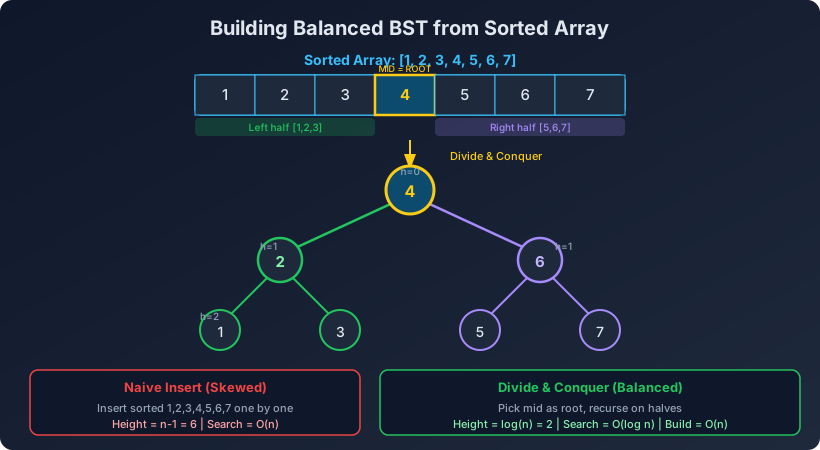
The problem with sorted insertion
Insert 1, 2, 3, 4, 5, 6, 7 into a BST one by one:
1
 \
  2
   \
    3
     \
      4
       \
        5
         \
          6
           \
            7

Height: 6 (should be 2)
Search time: O(n) instead of O(log n)
Every new value is larger than all existing values, so it always goes to the rightmost position. The same happens with reverse-sorted or nearly-sorted data.
Balanced BST from sorted array
The divide-and-conquer approach is elegant: the middle element becomes the root, which guarantees equal-sized subtrees.
Algorithm
- Find the middle element — make it the root
- Recursively build the left subtree from the left half
- Recursively build the right subtree from the right half
class TreeNode:
    def __init__(self, val=0, left=None, right=None):
        self.val = val
        self.left = left
        self.right = right

def sorted_array_to_bst(nums):
    """Convert sorted array to balanced BST (LeetCode 108)."""
    if not nums:
        return None

    def build(left, right):
        if left > right:
            return None

        mid = (left + right) // 2
        node = TreeNode(nums[mid])
        node.left = build(left, mid - 1)
        node.right = build(mid + 1, right)
        return node

return build(0, len(nums) - 1)Time: O(n) — each element is visited exactly once. Space: O(log n) — recursion depth for a balanced tree.
Step-by-step walkthrough
nums = [1, 2, 3, 4, 5, 6, 7]

# build(0, 6): mid=3, root=4
#   build(0, 2): mid=1, root=2
#     build(0, 0): mid=0, root=1 (leaf)
#     build(2, 2): mid=2, root=3 (leaf)
#   build(4, 6): mid=5, root=6
#     build(4, 4): mid=4, root=5 (leaf)
#     build(6, 6): mid=6, root=7 (leaf)

# Result:
#        4
#       / \
#      2   6
#     / \ / \
#    1  3 5  7
#
# Height = 2 = floor(log2(7))
# Perfectly balanced!
Why the middle element?
Choosing the middle guarantees that:
- Left half has
floor(n/2)elements - Right half has
floor(n/2)orceil(n/2) - 1elements - The difference in subtree sizes is at most 1
This recursively ensures the tree has minimum height.
Left-biased vs right-biased
When the array has an even number of elements, there are two valid midpoints:
# For [1, 2, 3, 4]:
# mid = (0+3)//2 = 1 → root=2 (left-biased)
# mid = (0+3+1)//2 = 2 → root=3 (right-biased)

# Both produce valid balanced BSTs:
#    2          3
#   / \        / \
#  1   3      2   4
#       \    /
#        4  1
Both are correct. LeetCode accepts either.
Balanced BST from sorted linked list
With a linked list, we cannot access the middle element in O(1). Two approaches:
Approach 1: Convert to array first
class ListNode:
    def __init__(self, val=0, next=None):
        self.val = val
        self.next = next

def sorted_list_to_bst_array(head):
    """Convert sorted linked list to BST via array conversion."""
    # Step 1: Convert to array O(n)
    nums = []
    current = head
    while current:
        nums.append(current.val)
        current = current.next

    # Step 2: Use the array approach
return sorted_array_to_bst(nums)Time: O(n). Space: O(n) for the array.
Approach 2: Simulate inorder traversal (O(1) extra space)
This clever approach builds the tree in inorder sequence, advancing a pointer through the linked list simultaneously:
def sorted_list_to_bst(head):
    """Convert sorted linked list to balanced BST without array.
    LeetCode 109.
    """
    # Count nodes
    length = 0
    current = head
    while current:
        length += 1
        current = current.next

    # Use a mutable reference to track current list position
    current_node = [head]

    def build(left, right):
        if left > right:
            return None

        mid = (left + right) // 2

        # Build left subtree first (inorder: left → root → right)
        left_child = build(left, mid - 1)

        # Current list node IS the current tree node
        node = TreeNode(current_node[0].val)
        node.left = left_child
        current_node[0] = current_node[0].next  # advance list pointer

        # Build right subtree
        node.right = build(mid + 1, right)

        return node

return build(0, length - 1)Time: O(n). Space: O(log n) — only recursion stack, no array.
How does this work?
The key insight: an inorder traversal of a BST visits nodes in sorted order. We build the tree in inorder sequence, and the sorted linked list provides values in exactly that order.
List: 1 → 2 → 3 → 4 → 5 → 6 → 7

build(0, 6): mid=3
  build(0, 2): mid=1
    build(0, 0): mid=0
      build(0, -1) → None (left child)
      node = TreeNode(1), advance to 2    ← first list value
      build(1, -1) → None (right child)
      return node(1)
    node = TreeNode(2), advance to 3      ← second list value
    build(2, 2): mid=2
      ...returns node(3)                  ← third list value
    return node(2)
  node = TreeNode(4), advance to 5        ← fourth list value (root!)
  build(4, 6): mid=5
    ...builds subtree [5, 6, 7]
  return node(4)
Converting BST to sorted doubly-linked list
The reverse problem: flatten a BST into a sorted circular doubly-linked list (LeetCode 426).
In-place conversion
def bst_to_dll(root):
    """Convert BST to sorted circular doubly-linked list.
    Uses left as 'prev' and right as 'next'.
    Returns the head (smallest node).
    """
    if not root:
        return None

    first = [None]  # smallest node (head of DLL)
    last = [None]   # previous node during inorder

    def inorder(node):
        if not node:
            return

        inorder(node.left)

        # Process current node
        if last[0]:
            # Link previous node to current
            last[0].right = node
            node.left = last[0]
        else:
            # First node (smallest)
            first[0] = node

        last[0] = node

        inorder(node.right)

    inorder(root)

    # Make it circular
    first[0].left = last[0]
    last[0].right = first[0]

    return first[0]
Walkthrough
BST:
    4
   / \
  2   6
 / \ / \
1  3 5  7

Inorder visit sequence: 1, 2, 3, 4, 5, 6, 7

After conversion (circular DLL):
... ↔ 1 ↔ 2 ↔ 3 ↔ 4 ↔ 5 ↔ 6 ↔ 7 ↔ ...
(7.right = 1, 1.left = 7)

Each node's 'left' is prev, 'right' is next.
Converting sorted DLL back to balanced BST
def dll_to_bst(head):
    """Convert sorted circular DLL back to balanced BST."""
    if not head:
        return None

    # Break the circular link and count nodes
    # Find tail
    tail = head.left
    tail.right = None
    head.left = None

    # Count nodes
    length = 0
    current = head
    while current:
        length += 1
        current = current.right

    # Build BST using the linked list approach
    current_node = [head]  # use head as starting point

    def build(left, right):
        if left > right:
            return None

        mid = (left + right) // 2
        left_child = build(left, mid - 1)

        node = current_node[0]
        node.left = left_child
        current_node[0] = current_node[0].right

        node.right = build(mid + 1, right)
        return node

    return build(0, length - 1)
Rebalancing an existing BST
Given an unbalanced BST, convert it to a balanced one (LeetCode 1382).
Approach 1: Inorder to array, then rebuild
def balance_bst(root):
    """Rebalance an existing BST."""
    # Step 1: Get sorted values via inorder traversal
    values = []
    def inorder(node):
        if node:
            inorder(node.left)
            values.append(node.val)
            inorder(node.right)
    inorder(root)

    # Step 2: Build balanced BST from sorted array
return sorted_array_to_bst(values)Time: O(n). Space: O(n) for the array.
Approach 2: Day-Stout-Warren algorithm (in-place)
The Day-Stout-Warren (DSW) algorithm rebalances a BST in-place using O(1) extra space. It works in three phases:
- Flatten the BST into a “vine” (right-only linked list) using right rotations
- Count the nodes
- Compress the vine into a balanced tree using left rotations
def dsw_balance(root):
    """Day-Stout-Warren algorithm for in-place BST rebalancing."""
    import math

    # Create a dummy root
    dummy = TreeNode(0)
    dummy.right = root

    # Phase 1: Tree to vine (right-leaning linked list)
    def tree_to_vine(root):
        """Flatten tree to vine using right rotations."""
        count = 0
        tail = root
        rest = tail.right

        while rest:
            if rest.left is None:
                tail = rest
                rest = rest.right
                count += 1
            else:
                # Right rotate
                temp = rest.left
                rest.left = temp.right
                temp.right = rest
                rest = temp
                tail.right = temp

        return count

    # Phase 2: Vine to balanced tree using left rotations
    def compress(root, count):
        """Perform 'count' left rotations starting from root."""
        scanner = root
        for _ in range(count):
            child = scanner.right
            scanner.right = child.right
            scanner = scanner.right
            child.right = scanner.left
            scanner.left = child

    node_count = tree_to_vine(dummy)

    # Phase 3: Calculate rotations needed
    # Number of nodes in the "full" part of the tree
    leaves = node_count + 1 - 2 ** int(math.log2(node_count + 1))
    compress(dummy, leaves)
    node_count -= leaves

    while node_count > 1:
        compress(dummy, node_count // 2)
        node_count //= 2

    return dummy.right
DSW walkthrough
Unbalanced BST:
1
 \
  2
   \
    3
     \
      4
       \
        5

Phase 1 (tree to vine): already a vine! count = 5

Phase 2 (vine to balanced):
leaves = 5 + 1 - 2^2 = 6 - 4 = 2
compress(dummy, 2): 2 left rotations

After first compression:
    2
   / \
  1   4
     / \
    3   5

compress(dummy, 1): 1 left rotation (at higher level... already close)

Final balanced tree:
      3        (or similar balanced shape)
     / \
    2   4
   /     \
  1       5

Height = 2 = floor(log2(5))Time: O(n). Space: O(1) — truly in-place!
Merge two BSTs into one balanced BST
def merge_bsts(root1, root2):
    """Merge two BSTs into one balanced BST."""
    # Step 1: Get sorted arrays from both BSTs
    def inorder(node, result):
        if node:
            inorder(node.left, result)
            result.append(node.val)
            inorder(node.right, result)

    arr1, arr2 = [], []
    inorder(root1, arr1)
    inorder(root2, arr2)

    # Step 2: Merge two sorted arrays
    merged = []
    i = j = 0
    while i < len(arr1) and j < len(arr2):
        if arr1[i] <= arr2[j]:
            merged.append(arr1[i])
            i += 1
        else:
            merged.append(arr2[j])
            j += 1
    merged.extend(arr1[i:])
    merged.extend(arr2[j:])

    # Step 3: Build balanced BST from merged sorted array
return sorted_array_to_bst(merged)Time: O(m + n) where m and n are the sizes of the two BSTs.
Verify balance
A helper to check if a BST is balanced:
def is_balanced(root):
    """Check if tree is height-balanced (LeetCode 110)."""
    def check(node):
        if not node:
            return 0

        left_h = check(node.left)
        if left_h == -1:
            return -1

        right_h = check(node.right)
        if right_h == -1:
            return -1

        if abs(left_h - right_h) > 1:
            return -1

        return 1 + max(left_h, right_h)

    return check(root) != -1
Complete test
# Test sorted array to BST
nums = list(range(1, 16))  # [1, 2, ..., 15]
root = sorted_array_to_bst(nums)

# Verify
print(is_balanced(root))  # True

# Check inorder produces sorted output
def get_inorder(node):
    if not node:
        return []
    return get_inorder(node.left) + [node.val] + get_inorder(node.right)

print(get_inorder(root) == nums)  # True

# Check height
def height(node):
    if not node:
        return 0
    return 1 + max(height(node.left), height(node.right))

print(height(root))  # 4 (log2(15) ≈ 3.9)
When to use each approach
| Scenario | Approach | Time | Space |
|---|---|---|---|
| Sorted array to BST | Divide and conquer | O(n) | O(log n) |
| Sorted linked list to BST | Inorder simulation | O(n) | O(log n) |
| Rebalance existing BST | Inorder + rebuild | O(n) | O(n) |
| Rebalance in-place | Day-Stout-Warren | O(n) | O(1) |
| Merge two BSTs | Inorder both + merge + build | O(m+n) | O(m+n) |
Practice problems
- Convert Sorted Array to BST (LeetCode 108) — The classic
- Convert Sorted List to BST (LeetCode 109) — Linked list version
- Balance a BST (LeetCode 1382) — Rebalance existing BST
- Check if Balanced (LeetCode 110) — Verify the result
- Flatten BST to Sorted List (LeetCode 897) — BST to linked list
- All Elements in Two BSTs (LeetCode 1305) — Merge sorted traversals
- Convert BST to Doubly Linked List (LeetCode 426)
- Minimum Height Trees (LeetCode 310) — Related concept
Key takeaways
- Sorted data kills BST performance — always build from the middle, not sequentially
- Divide and conquer on sorted arrays produces perfectly balanced BSTs in O(n)
- For sorted linked lists, simulate inorder traversal to avoid O(n) random access
- BST to sorted DLL is an inorder traversal that links nodes as it visits them
- Day-Stout-Warren is the only O(1) space rebalancing algorithm
- The pattern “inorder to array, rebuild from middle” solves many BST restructuring problems
Related articles
- DSA Flatten Binary Tree to Linked List
Learn how to flatten a binary tree to a linked list using preorder threading, Morris traversal, and how to convert a BST to a sorted doubly linked list — with full Python implementations and Big-O analysis.
- DSA BST Iterator, Range Queries, and Closest Value
Master BST iterator using stack-based controlled in-order traversal, range sum queries, counting nodes in range, closest value, and closest K values — with full Python implementations.
- DSA Boundary Traversal of Binary Tree
Complete guide to boundary traversal — left boundary, leaf nodes, and right boundary in reverse. Multiple Python approaches with edge case handling.
- DSA Distance Problems in Binary Trees
Solve distance problems in binary trees — distance between two nodes, all nodes at distance K, burning a tree from a node, and sum of distances using rerooting. Full Python implementations.