Sliding Window Maximum Using Deque
Solve the sliding window maximum problem in O(n) using a monotonic deque. Covers the algorithm, Python code, visual traces, and variations.
What you'll learn
- ✓Why a monotonic deque solves sliding window max in O(n)
- ✓How the deque maintains a decreasing order of useful elements
- ✓Sliding window minimum as a dual problem
- ✓Applications in stock analysis and signal processing
Prerequisites
- •Queue and deque basics — see Queues & Deques Deep Dive
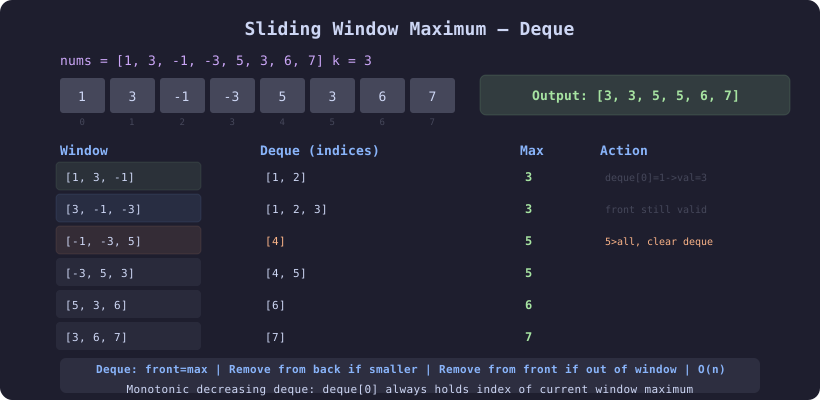
Given an array and a window size k, find the maximum element in each window as it slides from left to right.
The Problem
nums = [1, 3, -1, -3, 5, 3, 6, 7], k = 3

Window           Max
[1, 3, -1]       3
[3, -1, -3]      3
[-1, -3, 5]      5
[-3, 5, 3]       5
[5, 3, 6]        6
[3, 6, 7]        7
Brute Force — O(nk)
For each window, scan all k elements:
def max_sliding_window_brute(nums, k):
    return [max(nums[i:i+k]) for i in range(len(nums) - k + 1)]
Monotonic Deque — O(n)
Maintain a deque of indices where the values are in decreasing order. The front of the deque is always the maximum of the current window.
from collections import deque

def max_sliding_window(nums, k):
    """
    Find maximum in each sliding window of size k.
    Time: O(n), Space: O(k)
    """
    dq = deque()  # Indices, values in decreasing order
    result = []

    for i, num in enumerate(nums):
        # Remove elements outside the window
        while dq and dq[0] < i - k + 1:
            dq.popleft()

        # Remove elements smaller than current (they'll never be max)
        while dq and nums[dq[-1]] <= num:
            dq.pop()

        dq.append(i)

        # Window is fully formed
        if i >= k - 1:
            result.append(nums[dq[0]])

    return result
Trace
nums = [1, 3, -1, -3, 5, 3, 6, 7], k = 3

i=0, num=1:  dq=[0]         (push 0)
i=1, num=3:  dq=[1]         (pop 0 since 1<3, push 1)
i=2, num=-1: dq=[1,2]       (push 2) → max=nums[1]=3
i=3, num=-3: dq=[1,2,3]     (push 3) → max=nums[1]=3
i=4, num=5:  dq=[4]         (pop all since 5>all, remove 1 as out of window) → max=5
i=5, num=3:  dq=[4,5]       (push 5) → max=nums[4]=5
i=6, num=6:  dq=[6]         (pop all since 6>all) → max=6
i=7, num=7:  dq=[7]         (pop all since 7>all) → max=7

Result: [3, 3, 5, 5, 6, 7]
Why Monotonic Decreasing?
Elements smaller than the current element can never be the window maximum while the current element is in the window. So we discard them. The deque front is always the largest element still in the window.
Sliding Window Minimum
Just flip the comparison:
def min_sliding_window(nums, k):
    dq = deque()
    result = []

    for i, num in enumerate(nums):
        while dq and dq[0] < i - k + 1:
            dq.popleft()
        while dq and nums[dq[-1]] >= num:  # Changed <= to >=
            dq.pop()
        dq.append(i)
        if i >= k - 1:
            result.append(nums[dq[0]])

    return result
Complexity
| Metric | Value |
|---|---|
| Time | O(n) — each element enters and leaves deque once |
| Space | O(k) — deque holds at most k elements |
Edge Cases
- k = 1 — every element is its own window max
- k = n — single window, return overall max
- All same elements — every window max is the same
- Sorted ascending — deque always has one element
- Sorted descending — deque grows to k elements
When to Use Monotonic Deque
- Sliding window min/max
- Shortest subarray with sum ≥ k (deque for prefix sums)
- Jump Game VI (DP + sliding window max)
- Constrained subsequence sum
Related Problems
- Sliding Window Maximum (LeetCode 239)
- Shortest Subarray with Sum at Least K (LeetCode 862)
- Jump Game VI (LeetCode 1696)
- Longest Continuous Subarray with Abs Diff ≤ Limit (LeetCode 1438)
Related articles
- DSA Deque Design Patterns — Sliding Window, Palindrome, Work Stealing
Master deque design patterns including sliding window maximum, palindrome checking, work stealing, and BFS/DFS hybrid. Python implementations.
- DSA Design Front Middle Back Queue — Two Deques (LeetCode 1670)
Design Front Middle Back Queue using two balanced deques. Python solution with O(1) operations, step-by-step trace, and complexity analysis for LeetCode 1670.
- DSA Open the Lock — BFS on State Space (LeetCode 752)
Open the Lock problem solved with BFS on 4-digit state space. Python solution with deadend handling, bidirectional BFS optimization, and complexity analysis.
- DSA Shortest Subarray with Sum at Least K — Monotonic Deque (LeetCode 862)
Shortest Subarray with Sum at Least K solved with monotonic deque and prefix sums. Python solution with detailed trace, complexity analysis, and edge cases.