Linked List Intersection & Merge Point
Find where two linked lists intersect using the two-pointer technique, length difference method, and hash set — with Python implementations and complexity analysis.
What you'll learn
- ✓What linked list intersection means (shared nodes, not just equal values)
- ✓The elegant two-pointer technique for O(1) space
- ✓The length difference method
- ✓Hash set approach for comparison
- ✓Why intersection detection matters in memory management
- ✓Full Python implementations with edge cases
Prerequisites
- •Singly linked lists — see Linked Lists Intro
- •Big-O basics — see Big-O Notation
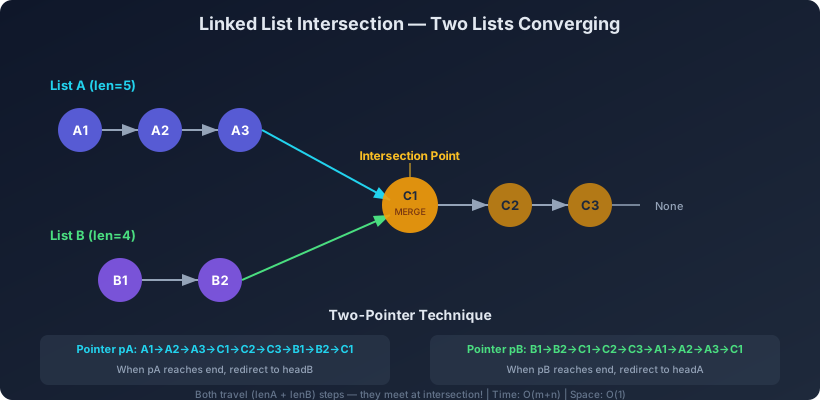
Two linked lists intersect when they share the same physical node — not just a node with the same value, but the exact same object in memory. After the intersection point, both lists share the same tail. Finding where they merge is a classic pointer problem with an elegant O(1) space solution.
Understanding Intersection
List A: A1 → A2 → A3 ↘
                        C1 → C2 → C3 → None
List B:      B1 → B2 ↗

Intersection node: C1
After C1, both lists share C1 → C2 → C3
Important: intersection means the same node object, not just the same value. If A has a node with value 5 and B has a different node with value 5, they do NOT intersect.
class ListNode:
    def __init__(self, val=0, next=None):
        self.val = val
        self.next = next
Approach 1: Hash Set — O(n + m) time, O(n) space
Visit every node in List A, store them in a set. Then walk List B and check:
def get_intersection_hashset(headA, headB):
    """
    Find intersection using a hash set.
    Time: O(n + m), Space: O(n)
    """
    visited = set()

    # Store all nodes from list A
    current = headA
    while current:
        visited.add(id(current))  # Use id() to compare identity
        current = current.next

    # Walk list B, check if any node was seen
    current = headB
    while current:
        if id(current) in visited:
            return current  # Intersection found!
        current = current.next

    return None  # No intersection
This works but uses O(n) extra space. We can do better.
Approach 2: Length Difference — O(n + m) time, O(1) space
If we know the lengths of both lists, we can align them so both pointers reach the intersection at the same time:
def get_length(head):
    """Count nodes in the list."""
    length = 0
    while head:
        length += 1
        head = head.next
    return length


def get_intersection_length(headA, headB):
    """
    Find intersection using length difference.
    Time: O(n + m), Space: O(1)
    """
    lenA = get_length(headA)
    lenB = get_length(headB)

    # Advance the longer list by the difference
    pA, pB = headA, headB
    if lenA > lenB:
        for _ in range(lenA - lenB):
            pA = pA.next
    else:
        for _ in range(lenB - lenA):
            pB = pB.next

    # Now both pointers are equidistant from the intersection
    while pA and pB:
        if pA is pB:
            return pA  # Intersection!
        pA = pA.next
        pB = pB.next

    return None
How it works
List A (length 5): A1 → A2 → A3 → C1 → C2
List B (length 4):      B1 → B2 → C1 → C2

Difference = 5 - 4 = 1
Advance pA by 1: pA starts at A2

Now:
pA: A2 → A3 → C1 → C2
pB: B1 → B2 → C1 → C2

Both travel 3 steps to reach C1 — they meet at the intersection!
Approach 3: Two-Pointer Technique — O(n + m) time, O(1) space
This is the most elegant solution. No need to calculate lengths:
def get_intersection_two_pointer(headA, headB):
    """
    Find intersection using the two-pointer technique.
    Time: O(n + m), Space: O(1)

    Key insight: When pA reaches the end of A, redirect it to headB.
    When pB reaches the end of B, redirect it to headA.
    Both will travel (lenA + lenB) steps total.
    If they intersect, they'll meet at the intersection.
    If not, they'll both reach None at the same time.
    """
    if not headA or not headB:
        return None

    pA = headA
    pB = headB

    # When pA reaches None, redirect to headB (and vice versa)
    while pA is not pB:
        pA = pA.next if pA else headB
        pB = pB.next if pB else headA

    return pA  # Either intersection node or None
Why does this work?
Let’s define:
a= nodes unique to List A (before intersection)b= nodes unique to List B (before intersection)c= shared nodes (from intersection to end)
Pointer A travels: a + c + b steps (A’s unique + shared + B’s unique)
Pointer B travels: b + c + a steps (B’s unique + shared + A’s unique)
Both travel a + b + c steps total. Since they travel the same distance and the last c nodes are shared, they must meet at the intersection node.
If there is no intersection (c = 0), both reach None after a + b steps.
# Example:
# A: [A1, A2, A3, C1, C2]  a=3, c=2
# B: [B1, B2, C1, C2]      b=2, c=2
#
# pA path: A1→A2→A3→C1→C2→None→B1→B2→C1 (meets at C1, 8 steps)
# pB path: B1→B2→C1→C2→None→A1→A2→A3→C1 (meets at C1, 8 steps)
Building Test Cases
def build_intersection_lists(a_vals, b_vals, shared_vals):
    """
    Build two lists that share a common tail.
    Returns (headA, headB, intersection_node)
    """
    # Build shared tail
    shared_head = None
    shared_tail = None
    for val in shared_vals:
        node = ListNode(val)
        if not shared_head:
            shared_head = node
            shared_tail = node
        else:
            shared_tail.next = node
            shared_tail = node

    # Build list A
    dummyA = ListNode(0)
    curr = dummyA
    for val in a_vals:
        curr.next = ListNode(val)
        curr = curr.next
    curr.next = shared_head  # Connect to shared part

    # Build list B
    dummyB = ListNode(0)
    curr = dummyB
    for val in b_vals:
        curr.next = ListNode(val)
        curr = curr.next
    curr.next = shared_head  # Connect to shared part

    return dummyA.next, dummyB.next, shared_head


# Test case 1: Lists with intersection
headA, headB, expected = build_intersection_lists(
    a_vals=[1, 2, 3],
    b_vals=[4, 5],
    shared_vals=[6, 7, 8]
)

result = get_intersection_two_pointer(headA, headB)
print(f"Intersection value: {result.val}")  # 6
assert result is expected, "Should be the same node object"

# Test case 2: No intersection
headX = ListNode(1, ListNode(2, ListNode(3)))
headY = ListNode(4, ListNode(5))

result = get_intersection_two_pointer(headX, headY)
print(f"No intersection: {result}")  # None

# Test case 3: One list is empty
result = get_intersection_two_pointer(None, headY)
print(f"Empty list: {result}")  # None

# Test case 4: Same list
result = get_intersection_two_pointer(headX, headX)
print(f"Same list: {result.val}")  # 1 (head is intersection)
Edge Cases to Handle
def get_intersection_safe(headA, headB):
    """Handle all edge cases."""
    # Both empty
    if not headA or not headB:
        return None

    # Same head — they're the same list
    if headA is headB:
        return headA

    # Standard two-pointer
    pA, pB = headA, headB
    while pA is not pB:
        pA = pA.next if pA else headB
        pB = pB.next if pB else headA

return pA| Edge Case | Result |
|---|---|
| Both lists empty | None |
| One list empty | None |
| No intersection | None |
| Same head node | Returns head |
| Intersection at last node | Returns last node |
| Equal length with intersection | Works normally |
| Very different lengths | Works normally |
Verifying Intersection Exists
Sometimes you just need a boolean:
def lists_intersect(headA, headB):
    """
    Check if two lists share a common tail.
    Time: O(n + m), Space: O(1)
    """
    if not headA or not headB:
        return False

    # Find tails
    tailA = headA
    while tailA.next:
        tailA = tailA.next

    tailB = headB
    while tailB.next:
        tailB = tailB.next

    # If tails are the same node, lists intersect
    return tailA is tailB
This is faster than finding the exact intersection point when you only need a yes/no answer.
Why Intersection Matters
Memory Management
In languages like C/C++, if two data structures share a linked list tail, you need to know about the intersection to avoid:
- Double free: Freeing the shared nodes twice causes a crash
- Use after free: One structure frees the shared nodes while the other still uses them
- Memory leaks: Neither structure frees the shared nodes because each assumes the other will
Graph Representations
In directed graphs represented with adjacency lists, two paths may merge at a common node. Finding merge points helps with:
- Detecting shared substructures
- Optimizing traversals by avoiding redundant work
- Finding least common ancestors in tree-like structures
Git Merge Base
Git’s merge-base command finds the common ancestor of two branches — conceptually similar to finding where two linked lists of commits intersect.
Comparison of Approaches
| Approach | Time | Space | Pros | Cons |
|---|---|---|---|---|
| Hash Set | O(n+m) | O(n) | Simple | Extra space |
| Length Difference | O(n+m) | O(1) | No extra space | Two passes |
| Two-Pointer | O(n+m) | O(1) | Elegant, one loop | Less intuitive |
| Tail Comparison | O(n+m) | O(1) | Only yes/no | No intersection node |
Finding All Shared Nodes
Once you find the intersection point, you can enumerate all shared nodes:
def get_shared_nodes(headA, headB):
    """
    Return a list of all shared node values after the intersection.
    """
    intersection = get_intersection_two_pointer(headA, headB)
    if not intersection:
        return []

    shared = []
    current = intersection
    while current:
        shared.append(current.val)
        current = current.next
    return shared


headA, headB, _ = build_intersection_lists([1, 2], [3], [4, 5, 6])
print(get_shared_nodes(headA, headB))  # [4, 5, 6]
Disconnecting Intersecting Lists
Sometimes you need to separate two intersecting lists:
def disconnect_lists(headA, headB):
    """
    If lists intersect, disconnect them so each has its own tail.
    Returns (headA, headB) — headB's tail becomes None.
    """
    intersection = get_intersection_two_pointer(headA, headB)
    if not intersection:
        return headA, headB  # Already separate

    # Find the node in list B just before the intersection
    if headB is intersection:
        # B starts at intersection — just return B as None
        return headA, None

    prev = headB
    while prev.next is not intersection:
        prev = prev.next

    prev.next = None  # Disconnect B from shared tail
    return headA, headB
Complexity Summary
| Operation | Time | Space |
|---|---|---|
| Two-pointer intersection | O(n + m) | O(1) |
| Hash set intersection | O(n + m) | O(n) |
| Length difference method | O(n + m) | O(1) |
| Check if intersecting | O(n + m) | O(1) |
Practice Problems
- LeetCode 160 — Intersection of Two Linked Lists: The classic problem (Easy)
- LeetCode 141 — Linked List Cycle: Related two-pointer technique (Easy)
- LeetCode 142 — Linked List Cycle II: Find the cycle start (Medium)
- LeetCode 1650 — Lowest Common Ancestor of a Binary Tree III: Similar merge-point concept with parent pointers (Medium)
- Git merge-base: Real-world application of finding common ancestors
Key Takeaways
- Linked list intersection means shared physical nodes, not just equal values.
- The two-pointer technique is the most elegant solution: redirect each pointer to the other list’s head when it reaches
None. Both travela + b + csteps and meet at the intersection. - The technique works because the total distance is equalized by the cross-redirection.
- Always check edge cases: empty lists, no intersection, same list, intersection at the head.
- Intersection detection is fundamental in memory management, garbage collection, and version control systems.
Related articles
- DSA Add Two Numbers as Linked Lists
Learn to add two numbers represented as linked lists — both reverse order (LeetCode 2) and forward order (LeetCode 445). Covers carry handling, different-length lists, and Python implementations with Big-O analysis.
- DSA Copy Linked List with Random Pointer
Learn two approaches to deep copy a linked list with random pointers — HashMap O(n) space and the interleaving O(1) space technique. Step-by-step walkthroughs with Python code and Big-O analysis.
- DSA Flatten a Multilevel Linked List
Learn to flatten a multilevel doubly linked list (LeetCode 430) and flatten sorted linked lists. Covers iterative and recursive DFS approaches with Python implementations and Big-O analysis.
- DSA Linked List Palindrome Check: Three Approaches
Learn three ways to check if a linked list is a palindrome — stack-based O(n) space, reverse-second-half O(1) space, and recursive. Step-by-step walkthroughs with Python code and Big-O analysis.