Deque Design Patterns — Sliding Window, Palindrome, Work Stealing
Master deque design patterns including sliding window maximum, palindrome checking, work stealing, and BFS/DFS hybrid. Python implementations.
What you'll learn
- ✓Four core deque design patterns with real use cases
- ✓Sliding window maximum with monotonic deque
- ✓Efficient palindrome checking using deque
- ✓Work stealing pattern from parallel computing
Prerequisites
- •Queue and deque basics — see Queues & Deques Deep Dive
- •Sliding window — see Sliding Window Maximum
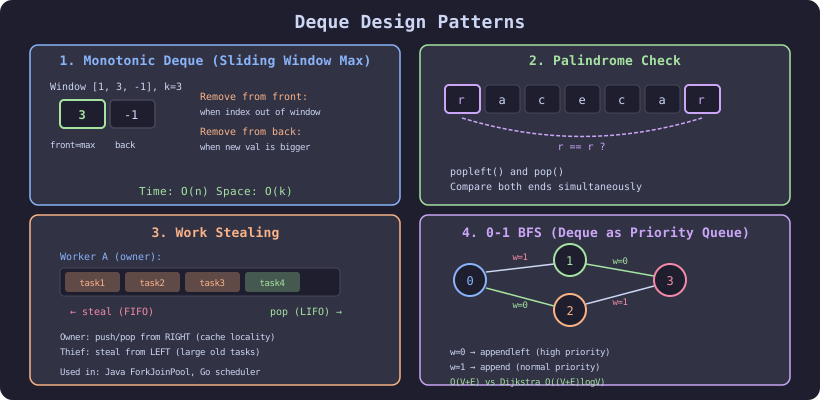
A deque (double-ended queue) supports O(1) insertion and removal from both ends. This makes it versatile for patterns that need access to both the front and back of a sequence.
from collections import deque

d = deque()
d.append(1)       # right end:  [1]
d.appendleft(2)   # left end:   [2, 1]
d.pop()           # right end:  [2]     returns 1
d.popleft()       # left end:   []      returns 2
Pattern 1: Monotonic Deque (Sliding Window Max/Min)
The most important deque pattern in interviews. Maintain a deque where elements are in decreasing order (for max) so the front always holds the current window’s maximum.
Problem: Sliding Window Maximum (LeetCode 239)
def max_sliding_window(nums: list[int], k: int) -> list[int]:
    """
    Find maximum in each sliding window of size k.
    Time: O(n), Space: O(k)
    """
    dq = deque()   # stores indices, values in decreasing order
    result = []

    for i, num in enumerate(nums):
        # Remove elements outside window
        while dq and dq[0] < i - k + 1:
            dq.popleft()

        # Remove smaller elements (they'll never be the max)
        while dq and nums[dq[-1]] <= num:
            dq.pop()

        dq.append(i)

        # Window is fully formed when i >= k-1
        if i >= k - 1:
            result.append(nums[dq[0]])

    return result
Trace: nums=[1,3,-1,-3,5,3,6,7], k=3
i=0: num=1   dq=[0]         (push 0)
i=1: num=3   dq=[1]         (1<3, pop 0, push 1)
i=2: num=-1  dq=[1,2]       (push 2)    → max=nums[1]=3
i=3: num=-3  dq=[1,2,3]     (push 3)    → max=nums[1]=3
i=4: num=5   dq=[4]         (pop all, push 4) → max=nums[4]=5
i=5: num=3   dq=[4,5]       (push 5)    → max=nums[4]=5
i=6: num=6   dq=[6]         (pop all, push 6) → max=nums[6]=6
i=7: num=7   dq=[7]         (pop all, push 7) → max=nums[7]=7

Result: [3, 3, 5, 5, 6, 7] ✓
Why Monotonic Deque Works
- Front of deque = index of maximum in current window
- When a larger element enters, smaller elements in deque are useless (they will never be the max while the larger element is in the window)
- Elements leave from the front when they fall outside the window
Pattern 2: Palindrome Checking
A deque lets you compare characters from both ends simultaneously.
def is_palindrome_deque(s: str) -> bool:
    """
    Check palindrome using deque.
    Time: O(n), Space: O(n)
    """
    # Clean string: lowercase, alphanumeric only
    d = deque(c.lower() for c in s if c.isalnum())

    while len(d) > 1:
        if d.popleft() != d.pop():
            return False

    return True
Trace: "racecar"
Deque: [r, a, c, e, c, a, r]
Compare r == r ✓  → [a, c, e, c, a]
Compare a == a ✓  → [c, e, c]
Compare c == c ✓  → [e]
Length <= 1 → True ✓
When This Beats Two Pointers
For simple strings, two pointers on an array works fine. But the deque approach shines when:
- Streaming data: Characters arrive one at a time — append to deque, check from both ends
- Partial palindrome: You can stop early and know which characters remain
- Deque already exists: If data is naturally in a deque, avoid converting
Pattern 3: Work Stealing (Parallel Computing)
In parallel computing, each thread has a deque of tasks. The owner pushes and pops from one end (like a stack), while idle threads steal from the other end.
class WorkStealingDeque:
    """
    Simulates work stealing scheduler.
    Owner: push/pop from RIGHT (LIFO for locality)
    Thieves: steal from LEFT (FIFO for load balance)
    """
    def __init__(self, worker_id: int):
        self.id = worker_id
        self.tasks = deque()

    def push_task(self, task):
        """Owner adds task (right end)."""
        self.tasks.append(task)

    def pop_task(self):
        """Owner takes task (right end — LIFO)."""
        if self.tasks:
            return self.tasks.pop()
        return None

    def steal_task(self):
        """Another worker steals (left end — FIFO)."""
        if self.tasks:
            return self.tasks.popleft()
        return None


def simulate_work_stealing(num_workers: int, tasks: list):
    """
    Distribute tasks, then let idle workers steal.
    """
    workers = [WorkStealingDeque(i) for i in range(num_workers)]

    # Distribute tasks round-robin
    for i, task in enumerate(tasks):
        workers[i % num_workers].push_task(task)

    # Process: each worker works its own deque,
    # idle workers steal from busiest
    results = []
    while any(w.tasks for w in workers):
        for w in workers:
            task = w.pop_task()
            if task is None:
                # Steal from another worker
                for other in workers:
                    if other.id != w.id:
                        task = other.steal_task()
                        if task:
                            break
            if task:
                results.append((w.id, task))

    return results
Why Deque for Work Stealing?
| End | Used By | Order | Why |
|---|---|---|---|
| Right (back) | Owner | LIFO | Cache locality — recent tasks are warm |
| Left (front) | Thief | FIFO | Steal oldest (largest) tasks first |
This is used in Java’s ForkJoinPool, Go’s goroutine scheduler, and Rust’s Rayon library.
Pattern 4: BFS/DFS Hybrid (0-1 BFS)
When edge weights are only 0 or 1, use a deque instead of a priority queue. Push 0-weight edges to the front, 1-weight edges to the back.
def shortest_path_01(graph: dict, start: int, end: int) -> int:
    """
    Shortest path with 0/1 edge weights using deque (0-1 BFS).
    Time: O(V + E), Space: O(V)
    """
    dist = {start: 0}
    dq = deque([start])

    while dq:
        node = dq.popleft()

        if node == end:
            return dist[node]

        for neighbor, weight in graph[node]:
            new_dist = dist[node] + weight
            if neighbor not in dist or new_dist < dist[neighbor]:
                dist[neighbor] = new_dist
                if weight == 0:
                    dq.appendleft(neighbor)  # front (high priority)
                else:
                    dq.append(neighbor)       # back (normal)

    return -1  # unreachable
Trace
Graph: 0 →(1)→ 1, 0 →(0)→ 2, 2 →(1)→ 3, 1 →(0)→ 3

Start: 0, End: 3

dq=[0]          dist={0:0}
Pop 0:
  → 1 (w=1)    dq=[1]       dist={0:0, 1:1}    (append)
  → 2 (w=0)    dq=[2,1]     dist={0:0, 1:1, 2:0}  (appendleft!)
Pop 2:
  → 3 (w=1)    dq=[1,3]     dist={..., 3:1}
Pop 1:
  → 3 (w=0)    dq=[3,3]     dist={..., 3:1}  (1+0=1, not better)
Pop 3:
  return 1 ✓
When 0-1 BFS Beats Dijkstra
| Algorithm | Time | Works For |
|---|---|---|
| Dijkstra | O((V+E) log V) | Any non-negative weights |
| 0-1 BFS | O(V + E) | Only 0 and 1 weights |
Complexity Summary
| Pattern | Time | Space | Key Deque Feature Used |
|---|---|---|---|
| Monotonic Deque | O(n) | O(k) | Pop from both ends |
| Palindrome Check | O(n) | O(n) | Compare front and back |
| Work Stealing | O(tasks) | O(tasks) | LIFO one end, FIFO other |
| 0-1 BFS | O(V+E) | O(V) | Appendleft for priority |
When to Use This Pattern
- Sliding window problems: Monotonic deque whenever you need min/max in a window
- Two-end processing: When you need to consume data from both ends
- Priority without heap: 0-1 BFS replaces priority queue for binary weights
- Parallel algorithms: Work stealing is fundamental to modern schedulers
Related Problems
- Sliding Window Maximum — deep dive on this specific problem
- Shortest Path in Binary Matrix — BFS on grids
- Queues and Deques Deep Dive — deque internals
Related articles
- DSA Shortest Subarray with Sum at Least K — Monotonic Deque (LeetCode 862)
Shortest Subarray with Sum at Least K solved with monotonic deque and prefix sums. Python solution with detailed trace, complexity analysis, and edge cases.
- DSA Design Front Middle Back Queue — Two Deques (LeetCode 1670)
Design Front Middle Back Queue using two balanced deques. Python solution with O(1) operations, step-by-step trace, and complexity analysis for LeetCode 1670.
- DSA Open the Lock — BFS on State Space (LeetCode 752)
Open the Lock problem solved with BFS on 4-digit state space. Python solution with deadend handling, bidirectional BFS optimization, and complexity analysis.
- DSA Sliding Window Maximum Using Deque
Solve the sliding window maximum problem in O(n) using a monotonic deque. Covers the algorithm, Python code, visual traces, and variations.