DP Palindrome Problems: LPS, Partition, Count Substrings & Shortest Palindrome
Master palindrome DP problems — longest palindromic subsequence, minimum cuts for palindrome partitioning, counting palindromic substrings, and shortest palindrome with KMP.
What you'll learn
- ✓How to find the longest palindromic subsequence using LCS
- ✓How to partition a string into minimum palindrome cuts
- ✓How expand-around-center counts palindromic substrings in O(n^2)
- ✓How Manacher's algorithm counts palindromes in O(n)
- ✓How to build the shortest palindrome using KMP
Prerequisites
- •Comfortable with DP fundamentals
- •Familiar with basic string operations
Palindrome problems sit at the intersection of string manipulation and dynamic programming. They appear frequently in interviews because they test both DP thinking and string insight. This post covers the four most important palindrome DP patterns.
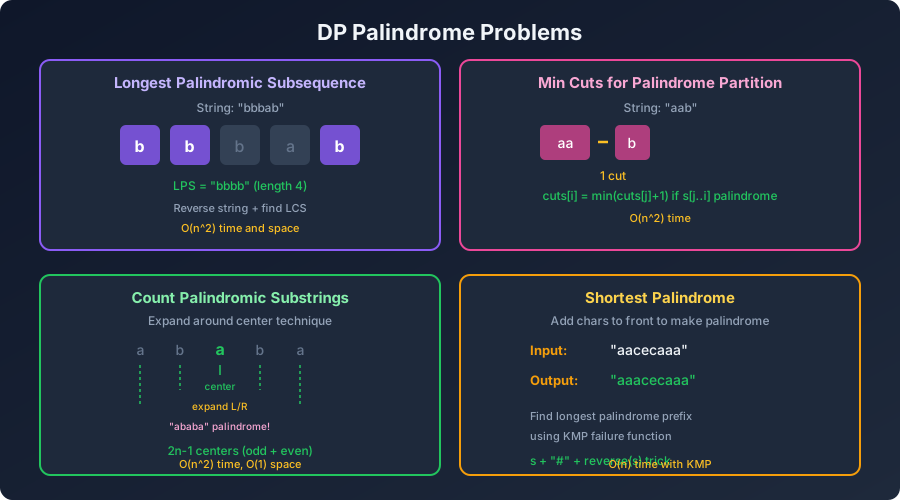
1. Longest Palindromic Subsequence (LPS)
Problem: Given a string s, find the length of the longest palindromic subsequence. (LeetCode 516)
A subsequence is not contiguous. For example, in "bbbab", the LPS is "bbbb" with length 4.
Approach 1: Reverse + LCS
The LPS of s equals the LCS (longest common subsequence) of s and reverse(s).
def longest_palindrome_subseq(s):
    n = len(s)
    rev = s[::-1]

    # LCS of s and reverse(s)
    dp = [[0] * (n + 1) for _ in range(n + 1)]

    for i in range(1, n + 1):
        for j in range(1, n + 1):
            if s[i - 1] == rev[j - 1]:
                dp[i][j] = dp[i - 1][j - 1] + 1
            else:
                dp[i][j] = max(dp[i - 1][j], dp[i][j - 1])

    return dp[n][n]
Time: O(n^2) | Space: O(n^2), reducible to O(n)
Approach 2: Direct Interval DP
dp[i][j] = LPS length of s[i..j].
def longest_palindrome_subseq_interval(s):
    n = len(s)
    dp = [[0] * n for _ in range(n)]

    # Every single character is a palindrome of length 1
    for i in range(n):
        dp[i][i] = 1

    # Fill diagonals from bottom-left to top-right
    for length in range(2, n + 1):
        for i in range(n - length + 1):
            j = i + length - 1
            if s[i] == s[j]:
                dp[i][j] = dp[i + 1][j - 1] + 2
            else:
                dp[i][j] = max(dp[i + 1][j], dp[i][j - 1])

    return dp[0][n - 1]
Space-Optimised to O(n)
def longest_palindrome_subseq_opt(s):
    n = len(s)
    dp = [0] * n
    dp_prev = [0] * n

    for i in range(n - 1, -1, -1):
        new_dp = [0] * n
        new_dp[i] = 1
        for j in range(i + 1, n):
            if s[i] == s[j]:
                new_dp[j] = dp[j - 1] + 2  # dp is the row i+1
            else:
                new_dp[j] = max(dp[j], new_dp[j - 1])
        dp = new_dp

    return dp[n - 1] if n > 0 else 0
2. Longest Palindromic Substring
Problem: Find the longest palindromic substring (contiguous). (LeetCode 5)
Expand Around Center
Every palindrome has a center. There are 2n - 1 possible centers (n for odd-length, n-1 for even-length). Expand outward from each center.
def longest_palindrome(s):
    n = len(s)
    if n == 0:
        return ""

    start, max_len = 0, 1

    def expand(left, right):
        nonlocal start, max_len
        while left >= 0 and right < n and s[left] == s[right]:
            if right - left + 1 > max_len:
                start = left
                max_len = right - left + 1
            left -= 1
            right += 1

    for i in range(n):
        expand(i, i)      # odd-length palindromes
        expand(i, i + 1)  # even-length palindromes

    return s[start:start + max_len]
Time: O(n^2) | Space: O(1)
DP Table Approach
def longest_palindrome_dp(s):
    n = len(s)
    if n <= 1:
        return s

    dp = [[False] * n for _ in range(n)]
    start, max_len = 0, 1

    # All single characters
    for i in range(n):
        dp[i][i] = True

    # Check length 2
    for i in range(n - 1):
        if s[i] == s[i + 1]:
            dp[i][i + 1] = True
            start, max_len = i, 2

    # Check lengths 3+
    for length in range(3, n + 1):
        for i in range(n - length + 1):
            j = i + length - 1
            if s[i] == s[j] and dp[i + 1][j - 1]:
                dp[i][j] = True
                start, max_len = i, length

    return s[start:start + max_len]
3. Palindrome Partitioning II (Minimum Cuts)
Problem: Given a string s, return the minimum number of cuts needed so every substring is a palindrome. (LeetCode 132)
Approach: Two Arrays
First, precompute whether s[i..j] is a palindrome. Then, find minimum cuts.
def min_cut(s):
    n = len(s)
    if n <= 1:
        return 0

    # is_pal[i][j] = True if s[i..j] is a palindrome
    is_pal = [[False] * n for _ in range(n)]
    for i in range(n):
        is_pal[i][i] = True
    for length in range(2, n + 1):
        for i in range(n - length + 1):
            j = i + length - 1
            if s[i] == s[j]:
                is_pal[i][j] = (length == 2) or is_pal[i + 1][j - 1]

    # cuts[i] = min cuts for s[0..i]
    cuts = list(range(n))  # worst case: cut every character

    for i in range(1, n):
        if is_pal[0][i]:
            cuts[i] = 0
            continue
        for j in range(1, i + 1):
            if is_pal[j][i]:
                cuts[i] = min(cuts[i], cuts[j - 1] + 1)

    return cuts[n - 1]
Time: O(n^2) | Space: O(n^2)
Optimised: Build Palindromes On-the-Fly
We can expand around centers while updating cuts, avoiding the separate is_pal table:
def min_cut_optimised(s):
    n = len(s)
    cuts = list(range(-1, n))  # cuts[i+1] = min cuts for s[0..i], cuts[0] = -1

    for center in range(n):
        # Odd-length palindromes
        left, right = center, center
        while left >= 0 and right < n and s[left] == s[right]:
            cuts[right + 1] = min(cuts[right + 1], cuts[left] + 1)
            left -= 1
            right += 1

        # Even-length palindromes
        left, right = center, center + 1
        while left >= 0 and right < n and s[left] == s[right]:
            cuts[right + 1] = min(cuts[right + 1], cuts[left] + 1)
            left -= 1
            right += 1

    return cuts[n]
Time: O(n^2) | Space: O(n)
4. Count Palindromic Substrings
Problem: Count the number of palindromic substrings in s. (LeetCode 647)
Expand Around Center
def count_substrings(s):
    n = len(s)
    count = 0

    for center in range(n):
        # Odd-length
        left, right = center, center
        while left >= 0 and right < n and s[left] == s[right]:
            count += 1
            left -= 1
            right += 1

        # Even-length
        left, right = center, center + 1
        while left >= 0 and right < n and s[left] == s[right]:
            count += 1
            left -= 1
            right += 1

    return count
Time: O(n^2) | Space: O(1)
Manacher’s Algorithm: O(n)
Manacher’s finds the longest palindrome centered at each position in linear time. It exploits symmetry: if you are inside a known palindrome, the radius at your position mirrors the radius at your “mirror” position.
def count_substrings_manacher(s):
    # Transform: "abc" -> "^#a#b#c#$"
    t = '^#' + '#'.join(s) + '#$'
    n = len(t)
    p = [0] * n  # p[i] = radius of palindrome centered at t[i]
    center = right = 0

    for i in range(1, n - 1):
        mirror = 2 * center - i
        if i < right:
            p[i] = min(right - i, p[mirror])

        # Expand
        while t[i + p[i] + 1] == t[i - p[i] - 1]:
            p[i] += 1

        # Update center
        if i + p[i] > right:
            center, right = i, i + p[i]

    # Count: each palindrome centered at '#' positions has even length,
    # each at character positions has odd length
    count = 0
    for i in range(1, n - 1):
        # p[i] at a '#' position: p[i]//2 even-length palindromes
        # p[i] at a char position: (p[i]+1)//2 odd-length palindromes
        count += (p[i] + 1) // 2 if t[i] != '#' else p[i] // 2

    return count
Time: O(n) | Space: O(n)
5. Shortest Palindrome
Problem: Given a string s, find the shortest palindrome you can form by adding characters only to the front. (LeetCode 214)
Key Insight
Find the longest palindrome prefix of s. Everything after that prefix needs to be reversed and prepended.
KMP Approach
Build the string s + "#" + reverse(s) and compute the KMP failure function. The last value of the failure array gives the length of the longest palindrome prefix.
def shortest_palindrome(s):
    if not s:
        return s

    rev = s[::-1]
    combined = s + '#' + rev

    # KMP failure function
    n = len(combined)
    fail = [0] * n

    for i in range(1, n):
        j = fail[i - 1]
        while j > 0 and combined[i] != combined[j]:
            j = fail[j - 1]
        if combined[i] == combined[j]:
            j += 1
        fail[i] = j

    # Length of longest palindrome prefix
    pal_len = fail[-1]

    # Add the remaining suffix (reversed) to the front
    suffix = s[pal_len:]
    return suffix[::-1] + s
Time: O(n) | Space: O(n)
Example Walkthrough
For s = "aacecaaa":
rev = "aaacecaa"combined = "aacecaaa#aaacecaa"- KMP failure function:
[0,1,0,0,0,1,2,2,0,1,2,2,3,4,5,6,7] fail[-1] = 7, so the palindrome prefix iss[0:7] = "aacecaa"- Remaining:
s[7:] = "a", reversed:"a" - Result:
"a" + "aacecaaa" = "aaacecaaa"
Rolling Hash Alternative
def shortest_palindrome_hash(s):
    if not s:
        return s

    n = len(s)
    MOD = (1 << 61) - 1
    BASE = 131
    prefix_hash = 0
    suffix_hash = 0
    power = 1
    best = 0

    for i in range(n):
        prefix_hash = (prefix_hash * BASE + ord(s[i])) % MOD
        suffix_hash = (suffix_hash + ord(s[i]) * power) % MOD
        power = (power * BASE) % MOD

        if prefix_hash == suffix_hash:
            best = i + 1

    suffix = s[best:]
    return suffix[::-1] + s
Time: O(n) | Space: O(1) (ignoring output string)
Palindrome DP Comparison
| Problem | State | Time | Space | Key Technique |
|---|---|---|---|---|
| Longest Palindromic Subseq | dp[i][j] interval | O(n^2) | O(n) | LCS with reverse |
| Longest Palindromic Substr | center expansion | O(n^2) | O(1) | Expand around center |
| Min Palindrome Cuts | cuts[i] | O(n^2) | O(n) | Expand + update cuts |
| Count Palindromic Substr | center expansion | O(n^2) | O(1) | Count during expansion |
| Shortest Palindrome | KMP failure | O(n) | O(n) | s + # + rev(s) |
Common Mistakes
- Confusing subsequence and substring: Subsequences are not contiguous, substrings are.
- Manacher off-by-one: The sentinel characters
^and$must be different from#and from all characters ins. - Palindrome partitioning:
cuts[i]starts ati(worst case), not atn. - KMP separator: The
#ins + "#" + rev(s)must not appear insto prevent false matches. - Even vs. odd palindromes: Always check both center types.
Practice Problems
| Problem | Platform | Difficulty |
|---|---|---|
| Longest Palindromic Subsequence | LeetCode 516 | Medium |
| Longest Palindromic Substring | LeetCode 5 | Medium |
| Palindrome Partitioning II | LeetCode 132 | Hard |
| Palindromic Substrings | LeetCode 647 | Medium |
| Shortest Palindrome | LeetCode 214 | Hard |
| Palindrome Partitioning | LeetCode 131 | Medium |
| Palindrome Partitioning IV | LeetCode 1745 | Hard |
| Longest Palindrome by Concatenating Two Letter Words | LeetCode 2131 | Medium |
Related articles
- DSA Knapsack DP Variants: 0/1, Unbounded, Fractional, Subset Sum & Target Sum
Master every knapsack variant — 0/1 knapsack, unbounded knapsack, fractional knapsack, subset sum, partition equal subset, and target sum with Python solutions and Big-O analysis.
- DSA Longest Subsequence Variants: LIS, Bitonic, Chain, Zigzag & Envelopes
Master longest subsequence problems — LIS with patience sorting, longest bitonic, chain of pairs, zigzag subsequence, Russian doll envelopes (2D LIS).
- DSA DP Grid Traversal: Unique Paths, Min Path Sum, Dungeon Game & Cherry Pickup
Master DP on grids — unique paths, minimum path sum, dungeon game, cherry pickup, and maximum path in grid with step-by-step Python solutions.
- DSA Stock Trading DP: All 6 Problems Solved with One Framework
Complete guide to all stock trading problems — I through IV, with cooldown, and with transaction fee. One unified state machine DP framework covers them all.