Online Stock Span — Class Design with Stack
Design an Online Stock Span class (LeetCode 901) using a stack. Covers amortized analysis, Python implementation, and the price-span pair technique.
What you'll learn
- ✓How to design a streaming stock span calculator
- ✓The price-span pair technique for O(1) amortized queries
- ✓Why this is different from the batch version
- ✓Amortized complexity analysis
Prerequisites
- •Stock span basics — see Stock Span Problem
- •Stack basics — see Stacks & Queues Intro
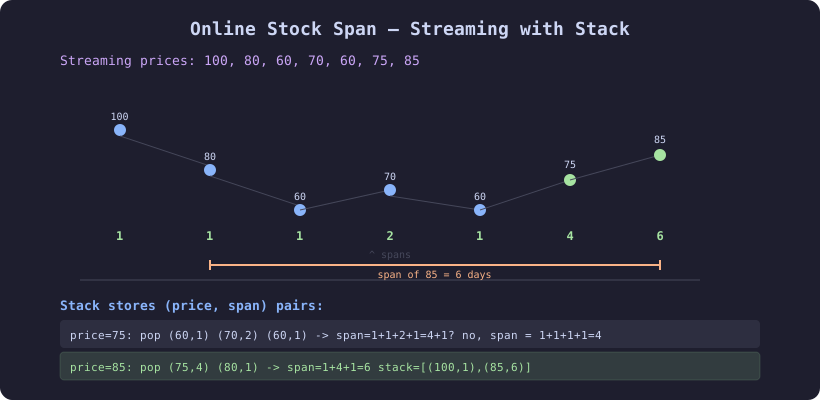
Design a class that collects daily stock prices and returns the span of each day’s price. The span is the number of consecutive days (ending today) where the price was less than or equal to today’s price.
The Challenge
Unlike the batch version where you have all prices upfront, here prices arrive one at a time via next(price). You can’t look ahead.
Solution — Price-Span Pairs
Store (price, span) pairs on the stack. When a new price arrives, pop all smaller-or-equal prices and absorb their spans.
class StockSpanner:
    def __init__(self):
        self.stack = []  # (price, span) pairs

    def next(self, price):
        """
        Return the span for this price.
        Time: O(1) amortized, Space: O(n)
        """
        span = 1

        while self.stack and self.stack[-1][0] <= price:
            span += self.stack.pop()[1]

        self.stack.append((price, span))
        return span
Trace
Call        | price | stack (price,span)      | span
------------|-------|-------------------------|-----
next(100)   | 100   | [(100,1)]               | 1
next(80)    | 80    | [(100,1),(80,1)]         | 1
next(60)    | 60    | [(100,1),(80,1),(60,1)]  | 1
next(70)    | 70    | pop(60,1) → span=2       | 2
            |       | [(100,1),(80,1),(70,2)]  |
next(60)    | 60    | [(100,1),(80,1),(70,2),(60,1)] | 1
next(75)    | 75    | pop(60,1),(70,2) → span=4| 4
            |       | [(100,1),(80,1),(75,4)]  |
next(85)    | 85    | pop(75,4),(80,1) → span=6| 6
            |       | [(100,1),(85,6)]         |
Why Price-Span Pairs?
When we pop a price, we lose information about the days it represented. By storing the accumulated span with each price, popping absorbs all the days that price covered. This is why we add stack.pop()[1] to the current span.
Amortized Analysis
Each price is pushed exactly once and popped at most once across all calls to next(). Over n calls:
- Total pushes = n
- Total pops ≤ n
- Total work = O(2n) = O(n)
- Amortized per call = O(1)
Worst case for a single call is O(n) (price higher than all previous), but this can’t happen every call.
Edge Cases
- First call — always returns 1
- Monotonically increasing — each call pops everything, span grows
- Monotonically decreasing — each call returns 1, stack grows
- All same prices — each new price absorbs all previous, span = call number
When to Use This Pattern
The price-span pair technique works for any online/streaming problem where:
- You need to aggregate information from elements you’re about to discard
- The aggregation is associative (sums, counts, max/min)
Related Problems
- Stock Span (batch) — index-based approach
- Next Greater Element (LeetCode 496/503)
- Daily Temperatures (LeetCode 739)
- Design patterns with amortized O(1) — similar to queue-from-two-stacks
Related articles
- DSA Implement Stack Using Two Queues — Two Approaches Explained
Implement a stack using two queues with costly push and costly pop approaches. Complete Python solutions with complexity analysis.
- DSA Asteroid Collision Problem Using Stacks
Solve the asteroid collision problem (LeetCode 735) using a stack. Covers collision rules, Python implementation, and all edge cases.
- DSA Car Fleet Problem — Stack-Based Arrival Time Solution
Solve LeetCode 853 Car Fleet using a stack. Sort by position, compare arrival times, and count fleets. Python solution with visual trace.
- DSA The Celebrity Problem Using Stack-Based Elimination
Solve the celebrity problem in O(n) time using a stack elimination technique. Includes proof of correctness, Python code, and matrix examples.