Binary Search Patterns: Templates, Rotated Arrays, and Answer Space
Master binary search with three templates -- exact match, first/last true, and answer space search. Covers rotated arrays, peak elements, and common off-by-one mistakes.
What you'll learn
- ✓Template 1: exact match binary search
- ✓Template 2: first true / lower bound (FFFTTT pattern)
- ✓Template 3: last true / upper bound (TTTFFF pattern)
- ✓Search in rotated sorted array
- ✓Peak element and bitonic array problems
- ✓Binary search on answer space (minimize maximum)
- ✓Common off-by-one mistakes and how to avoid them
Prerequisites
- •Basic understanding of Arrays and sorting
- •Familiar with Big-O Notation
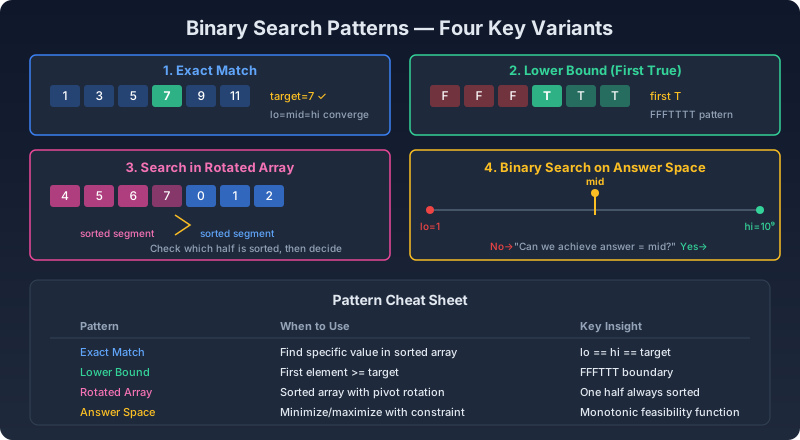
Why Binary Search Patterns Matter
Binary search looks simple, but it is one of the most error-prone algorithms to implement correctly. Off-by-one errors, infinite loops, and wrong boundary conditions plague even experienced programmers.
The solution is to learn templates — proven patterns that you can apply without reinventing the logic each time.
Template 1: Exact Match
The classic binary search: find a specific target in a sorted array.
def binary_search_exact(arr, target):
    """
    Find the index of target in sorted arr.
    Returns -1 if not found.
    """
    lo, hi = 0, len(arr) - 1

    while lo <= hi:
        mid = lo + (hi - lo) // 2  # Avoid overflow

        if arr[mid] == target:
            return mid
        elif arr[mid] < target:
            lo = mid + 1
        else:
            hi = mid - 1

    return -1


arr = [1, 3, 5, 7, 9, 11, 13]
print(binary_search_exact(arr, 7))    # 3
print(binary_search_exact(arr, 8))    # -1
print(binary_search_exact(arr, 1))    # 0
print(binary_search_exact(arr, 13))   # 6
Key Points
- Loop condition:
lo {'<'}= hi(both inclusive) - Termination:
lo {'>'} hi - No infinite loop risk:
loorhialways moves by at least 1 - Use case: Finding an exact value in a sorted array
Template 2: First True / Lower Bound
Given a monotonic boolean function f(x) that goes from False to True:
F F F F T T T T
          ^ find this
This is the most versatile template. It answers questions like:
- First element >= target (lower_bound)
- First position where a condition becomes true
- Insertion point in a sorted array
def first_true(lo, hi, condition):
    """
    Find the smallest x in [lo, hi] where condition(x) is True.
    Assumes condition goes F...F T...T (monotonic).
    Returns hi + 1 if condition is never True.
    """
    result = hi + 1  # Default: not found

    while lo <= hi:
        mid = lo + (hi - lo) // 2

        if condition(mid):
            result = mid    # mid could be the answer
            hi = mid - 1    # but check if there's an earlier True
        else:
            lo = mid + 1    # mid is False, answer must be to the right

    return result
Lower Bound (First element >= target)
def lower_bound(arr, target):
    """Find the first index where arr[i] >= target."""
    return first_true(0, len(arr) - 1, lambda mid: arr[mid] >= target)


arr = [1, 3, 3, 5, 7, 7, 7, 9, 11]
print(lower_bound(arr, 3))   # 1 (first 3)
print(lower_bound(arr, 7))   # 4 (first 7)
print(lower_bound(arr, 6))   # 4 (first element >= 6)
print(lower_bound(arr, 12))  # 9 (not found, returns len)
Upper Bound (First element > target)
def upper_bound(arr, target):
    """Find the first index where arr[i] > target."""
    return first_true(0, len(arr) - 1, lambda mid: arr[mid] > target)


arr = [1, 3, 3, 5, 7, 7, 7, 9, 11]
print(upper_bound(arr, 3))   # 3 (first element > 3)
print(upper_bound(arr, 7))   # 7 (first element > 7)
Count Occurrences of a Value
def count_occurrences(arr, target):
    """Count how many times target appears in sorted arr."""
    left = lower_bound(arr, target)
    right = upper_bound(arr, target)
    return right - left


arr = [1, 3, 3, 5, 7, 7, 7, 9, 11]
print(count_occurrences(arr, 7))   # 3
print(count_occurrences(arr, 3))   # 2
print(count_occurrences(arr, 6))   # 0
Template 3: Last True / Upper Bound
The mirror of Template 2. Given a function that goes True then False:
T T T T F F F F
      ^ find this
def last_true(lo, hi, condition):
"""
Find the largest x in [lo, hi] where condition(x) is True.
Assumes condition goes T...T F...F (monotonic).
Returns lo - 1 if condition is never True.
"""
result = lo - 1 # Default: not found
while lo <= hi:
mid = lo + (hi - lo) // 2
if condition(mid):
result = mid # mid could be the answer
lo = mid + 1 # check if there's a later True
else:
hi = mid - 1 # mid is False, answer must be to the left
return resultExample: Floor (Largest element <= target)
def floor(arr, target):
    """Find the largest element <= target."""
    idx = last_true(0, len(arr) - 1, lambda mid: arr[mid] <= target)
    return arr[idx] if 0 <= idx < len(arr) else None


arr = [1, 3, 5, 7, 9, 11]
print(floor(arr, 6))    # 5
print(floor(arr, 7))    # 7
print(floor(arr, 0))    # None
print(floor(arr, 12))   # 11
Search in Rotated Sorted Array
A sorted array rotated at some pivot. At least one half is always sorted.
def search_rotated(nums, target):
    """
    Search in rotated sorted array. LeetCode 33.
    Time: O(log n).
    """
    lo, hi = 0, len(nums) - 1

    while lo <= hi:
        mid = lo + (hi - lo) // 2

        if nums[mid] == target:
            return mid

        # Determine which half is sorted
        if nums[lo] <= nums[mid]:
            # Left half is sorted
            if nums[lo] <= target < nums[mid]:
                hi = mid - 1  # Target is in sorted left half
            else:
                lo = mid + 1  # Target is in right half
        else:
            # Right half is sorted
            if nums[mid] < target <= nums[hi]:
                lo = mid + 1  # Target is in sorted right half
            else:
                hi = mid - 1  # Target is in left half

    return -1


nums = [4, 5, 6, 7, 0, 1, 2]
print(search_rotated(nums, 0))    # 4
print(search_rotated(nums, 3))    # -1
print(search_rotated(nums, 6))    # 2
With Duplicates (LeetCode 81)
def search_rotated_duplicates(nums, target):
    """Search in rotated array that may contain duplicates."""
    lo, hi = 0, len(nums) - 1

    while lo <= hi:
        mid = lo + (hi - lo) // 2

        if nums[mid] == target:
            return True

        # Handle duplicates: if we can't determine which half is sorted
        if nums[lo] == nums[mid] == nums[hi]:
            lo += 1
            hi -= 1
        elif nums[lo] <= nums[mid]:
            if nums[lo] <= target < nums[mid]:
                hi = mid - 1
            else:
                lo = mid + 1
        else:
            if nums[mid] < target <= nums[hi]:
                lo = mid + 1
            else:
                hi = mid - 1

    return False
Find Minimum in Rotated Array
def find_min_rotated(nums):
    """Find minimum in rotated sorted array. LeetCode 153."""
    lo, hi = 0, len(nums) - 1

    while lo < hi:
        mid = lo + (hi - lo) // 2

        if nums[mid] > nums[hi]:
            lo = mid + 1  # Min is in right half
        else:
            hi = mid       # Mid could be min

    return nums[lo]


print(find_min_rotated([4, 5, 6, 7, 0, 1, 2]))  # 0
print(find_min_rotated([3, 1, 2]))                 # 1
print(find_min_rotated([1, 2, 3]))                 # 1
Peak Element
A peak element is strictly greater than its neighbors.
def find_peak_element(nums):
    """
    Find a peak element. LeetCode 162.
    nums[-1] and nums[n] are -infinity.
    Time: O(log n).
    """
    lo, hi = 0, len(nums) - 1

    while lo < hi:
        mid = lo + (hi - lo) // 2

        if nums[mid] < nums[mid + 1]:
            lo = mid + 1  # Peak is to the right
        else:
            hi = mid       # Peak is at mid or to the left

    return lo


print(find_peak_element([1, 2, 3, 1]))      # 2
print(find_peak_element([1, 2, 1, 3, 5, 6, 4]))  # 5 (or 1)
Binary Search on Answer Space
Instead of searching in an array, search for the answer itself. The idea:
- Define a range
[lo, hi]of possible answers. - For each candidate answer
mid, check if it is feasible. - If feasible, try a better answer (smaller or larger).
Minimize Maximum: Split Array into K Subarrays
def split_array(nums, k):
    """
    Split nums into k subarrays to minimize the maximum subarray sum.
    LeetCode 410.
    """
    def can_split(max_sum):
        """Can we split into <= k subarrays with each sum <= max_sum?"""
        count = 1
        current_sum = 0

        for num in nums:
            if current_sum + num > max_sum:
                count += 1
                current_sum = num
                if count > k:
                    return False
            else:
                current_sum += num

        return True

    lo = max(nums)       # At minimum, max_sum >= largest element
    hi = sum(nums)       # At maximum, one subarray holds everything

    result = hi
    while lo <= hi:
        mid = lo + (hi - lo) // 2

        if can_split(mid):
            result = mid
            hi = mid - 1   # Try smaller maximum
        else:
            lo = mid + 1   # Need larger maximum

    return result


nums = [7, 2, 5, 10, 8]
print(split_array(nums, 2))  # 18 (split: [7,2,5] and [10,8])
Koko Eating Bananas
import math

def min_eating_speed(piles, h):
    """
    Minimum eating speed to finish all bananas in h hours. LeetCode 875.
    """
    def can_finish(speed):
        hours = sum(math.ceil(pile / speed) for pile in piles)
        return hours <= h

    lo, hi = 1, max(piles)

    result = hi
    while lo <= hi:
        mid = lo + (hi - lo) // 2

        if can_finish(mid):
            result = mid
            hi = mid - 1
        else:
            lo = mid + 1

    return result


piles = [3, 6, 7, 11]
print(min_eating_speed(piles, 8))   # 4
print(min_eating_speed(piles, 30))  # 1
Capacity to Ship Packages
def ship_within_days(weights, days):
    """
    Minimum ship capacity to deliver all packages in 'days' days. LeetCode 1011.
    """
    def can_ship(capacity):
        day_count = 1
        current_load = 0

        for w in weights:
            if current_load + w > capacity:
                day_count += 1
                current_load = w
            else:
                current_load += w

        return day_count <= days

    lo = max(weights)
    hi = sum(weights)

    result = hi
    while lo <= hi:
        mid = lo + (hi - lo) // 2
        if can_ship(mid):
            result = mid
            hi = mid - 1
        else:
            lo = mid + 1

    return result


weights = [1, 2, 3, 4, 5, 6, 7, 8, 9, 10]
print(ship_within_days(weights, 5))  # 15
Common Mistakes and How to Avoid Them
Mistake 1: Overflow in Mid Calculation
# Wrong (can overflow in languages like C++/Java):
mid = (lo + hi) // 2

# Correct:
mid = lo + (hi - lo) // 2
Python handles big integers natively, but use the safe form for portability.
Mistake 2: Infinite Loop
# WRONG: infinite loop when lo == hi and condition sends to lo = mid
while lo < hi:
    mid = (lo + hi) // 2
    if condition(mid):
        hi = mid
    else:
        lo = mid  # BUG: when lo + 1 == hi, mid == lo, loop never ends

# FIX: use lo = mid + 1, or use mid = (lo + hi + 1) // 2 for the else branch
Mistake 3: Wrong Loop Condition
| Template | Loop condition | What lo/hi represent |
|---|---|---|
| Exact match | lo {'<'}= hi | Both inclusive |
| First/Last true | lo {'<'}= hi | Search space |
| Peak/Min | lo {'<'} hi | Converge to one element |
Mistake 4: Forgetting Edge Cases
Always test:
- Empty array
- Single element
- Target smaller than all elements
- Target larger than all elements
- All elements are the same
def test_binary_search():
    assert binary_search_exact([], 5) == -1
    assert binary_search_exact([5], 5) == 0
    assert binary_search_exact([5], 3) == -1
    assert lower_bound([1, 1, 1], 1) == 0
    assert lower_bound([1, 1, 1], 2) == 3
    print("All tests passed!")

test_binary_search()
Python’s bisect Module
Python provides bisect for binary search:
import bisect

arr = [1, 3, 3, 5, 7, 7, 7, 9, 11]

# bisect_left = lower_bound (first >= target)
print(bisect.bisect_left(arr, 7))    # 4

# bisect_right = upper_bound (first > target)
print(bisect.bisect_right(arr, 7))   # 7

# Insert while maintaining sorted order
bisect.insort(arr, 6)
print(arr)  # [1, 3, 3, 5, 6, 7, 7, 7, 9, 11]

# Check if value exists
def binary_search(arr, target):
    idx = bisect.bisect_left(arr, target)
    return idx < len(arr) and arr[idx] == target

print(binary_search(arr, 7))   # True
print(binary_search(arr, 8))   # False
Practice Problems
- Binary Search (LeetCode 704) — Template 1.
- First Bad Version (LeetCode 278) — Template 2 (first True).
- Search Insert Position (LeetCode 35) — Lower bound.
- Search in Rotated Sorted Array (LeetCode 33) — Rotated pattern.
- Find Peak Element (LeetCode 162) — Peak pattern.
- Split Array Largest Sum (LeetCode 410) — Answer space.
- Koko Eating Bananas (LeetCode 875) — Answer space.
- Capacity to Ship Packages (LeetCode 1011) — Answer space.
- Find Minimum in Rotated Array (LeetCode 153) — Rotated pattern.
- Median of Two Sorted Arrays (LeetCode 4) — Advanced binary search.
Key Takeaways
- Learn three templates: exact match, first true (FFFTTT), and last true (TTTFFF). These cover almost every binary search variant.
- In rotated arrays, one half is always sorted. Check which half, then decide where the target could be.
- Binary search on answer space transforms optimization problems into decision problems: “Can I achieve answer = mid?”
- Always use
mid = lo + (hi - lo) // 2to avoid overflow. - Test edge cases: empty array, single element, target outside range, all duplicates.
- Python’s
bisectmodule provides battle-tested implementations for lower/upper bound.
Related articles
- DSA Binary Search on Answer: Advanced Problems
Solve advanced binary search on answer problems — Koko eating bananas, ship packages, split array largest sum, minimize max distance to gas station, and magnetic force between balls.
- DSA Binary Search on Answer Technique
Learn to binary search on the answer space — the powerful technique behind problems like splitting arrays, Koko eating bananas, and capacity to ship packages.
- DSA Longest Increasing Subsequence: DP and Patience
Longest Increasing Subsequence in detail — the O(n^2) DP, the O(n log n) patience-sorting trick with binary search, and when each one matters.
- DSA Search in Rotated Sorted Array: Modified Binary Search
Solve Search in Rotated Sorted Array in O(log n) with modified binary search. Pivot detection, half-decision logic, and interview talking points.