Jump Game III and IV — BFS with Queue
Solve Jump Game III (LeetCode 1306) and Jump Game IV (LeetCode 1345) using BFS. Covers graph modeling of array problems with queue-based traversal.
What you'll learn
- ✓How to model array jumping problems as graph BFS
- ✓Jump Game III: can you reach value 0?
- ✓Jump Game IV: minimum jumps with same-value teleportation
- ✓Optimization tricks for BFS on arrays
Prerequisites
- •BFS pattern — see BFS with Queues
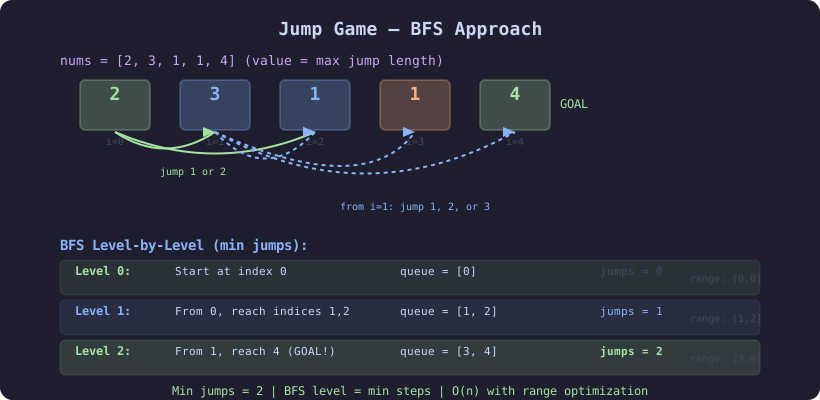
Some Jump Game variants are naturally BFS problems — you’re finding the shortest path in an implicit graph where nodes are array indices and edges are valid jumps.
Jump Game III (LeetCode 1306)
From index start, you can jump to i + arr[i] or i - arr[i]. Can you reach any index with value 0?
from collections import deque

def can_reach(arr, start):
    """
    BFS to check if any index with value 0 is reachable.
    Time: O(n), Space: O(n)
    """
    n = len(arr)
    queue = deque([start])
    visited = {start}

    while queue:
        i = queue.popleft()

        if arr[i] == 0:
            return True

        for next_i in [i + arr[i], i - arr[i]]:
            if 0 <= next_i < n and next_i not in visited:
                visited.add(next_i)
                queue.append(next_i)

    return False
Trace
arr = [4, 2, 3, 0, 3, 1, 2], start = 5

i=5, val=1: jump to 6, 4
i=6, val=2: jump to (8 invalid), 4 (visited via i=5? no, add)
i=4, val=3: jump to 7 (invalid), 1
i=1, val=2: jump to 3, (−1 invalid)
i=3, val=0: FOUND! → return True
Jump Game IV (LeetCode 1345)
Minimum jumps from index 0 to index n-1. From index i, you can:
- Jump to i+1
- Jump to i-1
- Jump to any index j where
arr[j] == arr[i](same value teleport)
from collections import deque, defaultdict

def min_jumps(arr):
    """
    Minimum jumps to reach last index.
    Time: O(n), Space: O(n)
    """
    n = len(arr)
    if n == 1:
        return 0

    # Build same-value groups
    val_to_indices = defaultdict(list)
    for i, val in enumerate(arr):
        val_to_indices[val].append(i)

    queue = deque([(0, 0)])  # (index, jumps)
    visited = {0}

    while queue:
        i, jumps = queue.popleft()

        for next_i in [i-1, i+1] + val_to_indices.get(arr[i], []):
            if next_i == n - 1:
                return jumps + 1

            if 0 <= next_i < n and next_i not in visited:
                visited.add(next_i)
                queue.append((next_i, jumps + 1))

        # Clear group to avoid revisiting — critical optimization
        if arr[i] in val_to_indices:
            del val_to_indices[arr[i]]

    return -1
Why Delete the Group?
Without clearing val_to_indices[arr[i]] after processing, same-value groups cause O(n²) behavior. Consider [7,7,7,7,7,7,7,11] — without clearing, index 0 enqueues all 7s, index 1 tries to enqueue them again, etc.
After BFS processes any index with value 7, ALL indices with value 7 are already in the queue or visited. We’ll never need the group again.
Comparison
| Problem | Edges | Key Trick |
|---|---|---|
| Jump Game III | i±arr[i] | Standard BFS |
| Jump Game IV | i±1, same-value | Clear groups after use |
Edge Cases
- Single element — already at target, return 0
- All same values — one teleport jump reaches the end
- Alternating values — step through normally
- Large arrays with many duplicates — group clearing prevents TLE
When to Use BFS for Array Problems
Model the array as a graph when:
- Each index has multiple possible “next” indices
- You need the minimum number of steps/jumps
- The cost of each move is uniform (unweighted)
Related Problems
- Jump Game (LeetCode 55) — greedy, can you reach end?
- Jump Game II (LeetCode 45) — greedy, minimum jumps
- Minimum Genetic Mutation (LeetCode 433) — BFS on strings
- Open the Lock (LeetCode 752) — BFS on states
Related articles
- DSA BFS Pattern with Queues: Level-Order and Shortest Path
Master BFS using queues for tree level-order traversal and shortest path in unweighted graphs. Python implementations with detailed traces.
- DSA Design Circular Deque — Array-Based Implementation (LeetCode 641)
Design a Circular Deque with front/rear pointers on a fixed-size array. Python solution with all O(1) operations, visual trace, and edge case handling.
- DSA Design Hit Counter Using Queue
Design a hit counter that counts hits in the past 5 minutes using a queue. LeetCode 362 solution with O(1) amortized operations.
- DSA First Non-Repeating Character in a Stream
Find the first non-repeating character in a character stream using a queue and hash map. Python solution with O(1) amortized per query.