Embedding Models Compared: OpenAI, Cohere, and Open-Source
Compare text-embedding-3-small/large, Cohere embed-v3, and sentence-transformers on dimensions, cost, MTEB scores, and practical RAG performance.
What you'll learn
- ✓Key differences between OpenAI, Cohere, and open-source embedding models
- ✓How to read MTEB benchmark scores and what they mean for your use case
- ✓Dimension, cost, and latency trade-offs for each model
- ✓How to generate embeddings with each provider in Python
- ✓Decision framework for choosing the right model for your RAG pipeline
Prerequisites
- •RAG Embeddings Explained for the fundamentals of vector representations
- •Chunking Strategies covers preparing text before embedding
- •Basic Python — see What Is Python?
Your choice of embedding model determines how well your RAG system retrieves relevant documents. A weak model misses relevant passages. An expensive model burns budget on every query. This guide compares the leading options across dimensions, cost, benchmark performance, and practical use.
The contenders
We are comparing five models across three providers:
| Model | Provider | Dimensions | Max Tokens | Pricing (per 1M tokens) |
|---|---|---|---|---|
| text-embedding-3-small | OpenAI | 1536 | 8191 | $0.02 |
| text-embedding-3-large | OpenAI | 3072 | 8191 | $0.13 |
| embed-v3 (english) | Cohere | 1024 | 512 | $0.10 |
| e5-large-v2 | Open-source | 1024 | 512 | Free (self-hosted) |
| bge-large-en-v1.5 | Open-source | 1024 | 512 | Free (self-hosted) |
MTEB benchmark scores
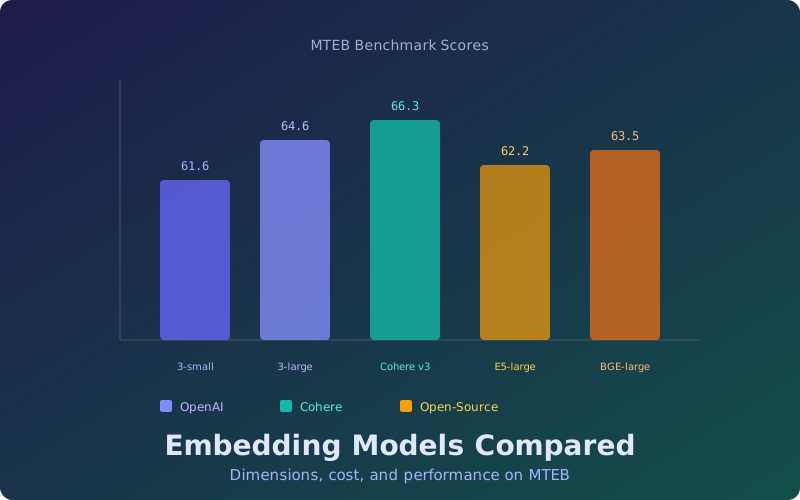
The Massive Text Embedding Benchmark (MTEB) evaluates models across retrieval, classification, clustering, and semantic textual similarity tasks. Higher is better.
| Model | Retrieval (avg) | Classification | STS | Overall |
|---|---|---|---|---|
| text-embedding-3-small | 59.2 | 65.1 | 78.0 | 61.6 |
| text-embedding-3-large | 62.4 | 68.3 | 81.2 | 64.6 |
| embed-v3 | 64.5 | 69.7 | 82.1 | 66.3 |
| e5-large-v2 | 60.1 | 65.8 | 79.4 | 62.2 |
| bge-large-en-v1.5 | 61.4 | 66.9 | 80.3 | 63.5 |
Cohere embed-v3 leads on retrieval, which is the metric that matters most for RAG. OpenAI’s 3-large is close behind. The open-source models (E5, BGE) are competitive, especially considering they are free to run.
OpenAI: text-embedding-3-small and 3-large
OpenAI’s embedding API is the easiest to start with. One API call, no GPU needed.
from openai import OpenAI

client = OpenAI()

def embed_openai(texts: list[str], model: str = "text-embedding-3-small") -> list[list[float]]:
    """Generate embeddings using OpenAI's API."""
    response = client.embeddings.create(input=texts, model=model)
    return [item.embedding for item in response.data]

# Embed documents
chunks = ["RAG retrieves relevant documents...", "Chunking splits text into..."]
vectors = embed_openai(chunks)
print(f"Dimensions: {len(vectors[0])}")  # 1536 for 3-small
A useful feature of the 3-series models is dimension reduction. You can request fewer dimensions to shrink your vector index without re-embedding:
response = client.embeddings.create(
    input=["example text"],
    model="text-embedding-3-large",
    dimensions=1024,  # reduce from 3072 to 1024
)
This uses Matryoshka Representation Learning — the first N dimensions retain most of the information. Going from 3072 to 1024 typically costs less than 1% retrieval accuracy.
When to choose OpenAI: You want zero infrastructure, fast integration, and your budget allows API costs. Start with 3-small; upgrade to 3-large only if retrieval recall on your eval set justifies the 6.5x cost increase.
Cohere: embed-v3
Cohere’s embed-v3 currently leads the MTEB retrieval leaderboard. It also introduces input types, letting you tell the model whether the text is a search_document or a search_query, which improves asymmetric search.
import cohere

co = cohere.ClientV2("your-api-key")

def embed_cohere(
    texts: list[str],
    input_type: str = "search_document",
    model: str = "embed-english-v3.0",
) -> list[list[float]]:
    """Generate embeddings using Cohere's API."""
    response = co.embed(
        texts=texts,
        model=model,
        input_type=input_type,
        embedding_types=["float"],
    )
    return response.embeddings.float_

# Embed documents with document type
doc_vectors = embed_cohere(
    ["RAG retrieves relevant documents..."],
    input_type="search_document",
)

# Embed queries with query type
query_vector = embed_cohere(
    ["How does RAG work?"],
    input_type="search_query",
)
The input_type distinction is important. Documents get embedded differently from queries because the model learns that queries are short and documents are longer. Mixing these up can hurt retrieval by 3-5%.
When to choose Cohere: You need the best retrieval quality and are willing to learn a slightly more complex API. Cohere also offers excellent multilingual support with embed-multilingual-v3.0.
Open-source: sentence-transformers
If you want to self-host — for privacy, cost control, or offline use — the sentence-transformers library gives you access to hundreds of models.
from sentence_transformers import SentenceTransformer

# BGE-large is one of the best open-source options
model = SentenceTransformer("BAAI/bge-large-en-v1.5")

def embed_local(texts: list[str]) -> list[list[float]]:
    """Generate embeddings locally with sentence-transformers."""
    embeddings = model.encode(
        texts,
        normalize_embeddings=True,
        show_progress_bar=True,
        batch_size=32,
    )
    return embeddings.tolist()

vectors = embed_local(["RAG retrieves relevant documents..."])
print(f"Dimensions: {len(vectors[0])}")  # 1024
For production, you will want a GPU. On an A10G, BGE-large embeds roughly 500 passages per second. On CPU, expect 20-50 per second.
The top open-source models to consider:
| Model | Parameters | Dimensions | MTEB Retrieval |
|---|---|---|---|
| bge-large-en-v1.5 | 335M | 1024 | 61.4 |
| e5-large-v2 | 335M | 1024 | 60.1 |
| gte-large | 335M | 1024 | 60.8 |
| all-MiniLM-L6-v2 | 22M | 384 | 49.5 |
all-MiniLM-L6-v2 is worth noting — it is 15x smaller and much faster. For prototypes or latency-sensitive applications, it is a reasonable trade-off.
When to choose open-source: Your data cannot leave your infrastructure, you are embedding millions of documents (API costs would be prohibitive), or you need to fine-tune the model on domain-specific data.
Practical comparison: cost at scale
Suppose you have 1 million documents averaging 500 tokens each. Here is the cost to embed them all:
| Model | Cost to embed 1M docs | Monthly query cost (100k queries) |
|---|---|---|
| text-embedding-3-small | $10 | $0.10 |
| text-embedding-3-large | $65 | $0.65 |
| embed-v3 | $50 | $0.50 |
| bge-large (self-hosted, A10G) | ~$30/month GPU | $0 marginal |
At small scale, API-based models are cheaper (no GPU rental). At large scale, self-hosting wins because the marginal cost per embedding approaches zero.
Decision framework
Use this flowchart:
- Can your data leave your infrastructure? If no, use open-source (BGE-large or E5-large).
- Do you need multilingual support? If yes, Cohere embed-multilingual-v3 is the best option.
- Is retrieval quality the top priority? Cohere embed-v3 leads on retrieval benchmarks.
- Is simplicity the top priority? OpenAI 3-small is the easiest to integrate.
- Embedding millions of documents? Self-host to avoid API costs.
- Prototyping? Start with OpenAI 3-small. It is cheap and fast to integrate. Switch later if recall is insufficient.
Tips for production
- Always normalize embeddings — use cosine similarity, not dot product, unless you are sure your model was trained for dot product.
- Batch your API calls — OpenAI allows up to 2048 inputs per call. Cohere allows 96. Batching reduces latency and avoids rate limits.
- Cache embeddings — never re-embed the same text twice. Store vectors alongside your chunks.
- Evaluate on your data — MTEB scores are averages across many datasets. Your domain may favor a different model. Build a test set of 50-100 queries with known relevant documents and measure recall@10.
What’s next
You have chunks and vectors. The next question is how to search them effectively. The next article, Hybrid Search for RAG, covers combining dense vector search with sparse keyword search for better retrieval.
Related articles
- Embeddings & RAG Chunking Strategies for RAG: A Complete Guide
Learn fixed-size, semantic, recursive, and document-aware chunking strategies for RAG pipelines. Includes overlap techniques, benchmarks, and Python code.
- Embeddings & RAG Hybrid Search for RAG: Combining Dense and Sparse Retrieval
Learn how to combine BM25 keyword search with vector similarity using reciprocal rank fusion for better RAG retrieval. Includes Python code and benchmarks.
- Embeddings & RAG RAG Evaluation Metrics: Measuring Retrieval and Generation Quality
Learn to evaluate RAG pipelines with Recall@k, MRR, NDCG for retrieval and faithfulness, relevance, hallucination rate for generation. Includes RAGAS setup.
- LLMs LLM Fine-tuning vs Prompting Trade-offs
Decide between prompt engineering, retrieval, and fine-tuning by weighing cost, latency, control, and data requirements honestly.