Suffix Arrays: Construction, LCP, and Applications
Learn suffix arrays from scratch -- naive and O(n log^2 n) construction, LCP arrays, pattern searching with binary search, and applications like longest repeated substring.
What you'll learn
- ✓What a suffix array is and why it matters
- ✓Naive O(n^2 log n) and efficient O(n log^2 n) construction
- ✓What the LCP array is and how to build it in O(n)
- ✓Pattern searching using suffix array + binary search
- ✓Applications: longest repeated substring, distinct substrings count
- ✓Complete Python implementations
Prerequisites
- •Comfortable with sorting and binary search
- •Familiar with Big-O Notation
- •Basic string manipulation skills
What is a Suffix Array?
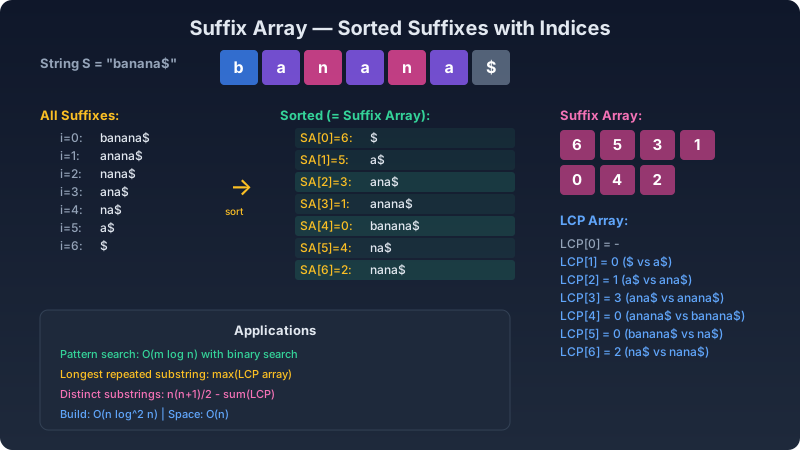
A suffix array is a sorted array of all suffixes of a string, represented by their starting indices.
For S = "banana$":
| Suffix | Starting Index |
|---|---|
| banana$ | 0 |
| anana$ | 1 |
| nana$ | 2 |
| ana$ | 3 |
| na$ | 4 |
| a$ | 5 |
| $ | 6 |
After sorting alphabetically:
| Rank | Suffix | SA Value |
|---|---|---|
| 0 | $ | 6 |
| 1 | a$ | 5 |
| 2 | ana$ | 3 |
| 3 | anana$ | 1 |
| 4 | banana$ | 0 |
| 5 | na$ | 4 |
| 6 | nana$ | 2 |
Suffix Array = [6, 5, 3, 1, 0, 4, 2]
The $ sentinel character ensures no suffix is a prefix of another (important for correctness).
Naive Construction: O(n^2 log n)
The simplest approach: generate all suffixes, sort them.
def suffix_array_naive(s):
    """Build suffix array by sorting all suffixes. O(n^2 log n)."""
    n = len(s)
    # Create list of (suffix, index) and sort
    suffixes = [(s[i:], i) for i in range(n)]
    suffixes.sort()
    return [idx for _, idx in suffixes]


s = "banana$"
sa = suffix_array_naive(s)
print(f"Suffix Array: {sa}")
# Suffix Array: [6, 5, 3, 1, 0, 4, 2]

# Print sorted suffixes
for rank, idx in enumerate(sa):
    print(f"  SA[{rank}] = {idx}: {s[idx:]}")
This is O(n^2 log n) because sorting n strings of average length n/2 takes O(n * n * log n) in the worst case (each comparison is O(n)).
Efficient Construction: O(n log^2 n)
The key idea: sort suffixes by their first 2^k characters, doubling k each round. We use the rank from the previous round to compare in O(1) instead of O(n).
def suffix_array_efficient(s):
    """
    Build suffix array in O(n log^2 n) using prefix doubling.
    Each sorting round uses O(n log n) with built-in sort.
    """
    n = len(s)

    # Initial ranking: by single character
    sa = list(range(n))
    rank = [ord(c) for c in s]
    tmp = [0] * n

    k = 1  # Current comparison length
    while k < n:
        # Sort by (rank[i], rank[i + k])
        # Using the pair as a sort key
        def sort_key(i):
            return (rank[i], rank[i + k] if i + k < n else -1)

        sa.sort(key=sort_key)

        # Compute new ranks
        tmp[sa[0]] = 0
        for i in range(1, n):
            tmp[sa[i]] = tmp[sa[i - 1]]
            if sort_key(sa[i]) != sort_key(sa[i - 1]):
                tmp[sa[i]] += 1

        rank = tmp[:]

        # If all ranks are unique, we're done
        if rank[sa[-1]] == n - 1:
            break

        k *= 2

    return sa


s = "banana$"
sa = suffix_array_efficient(s)
print(f"Suffix Array: {sa}")
# Suffix Array: [6, 5, 3, 1, 0, 4, 2]
How Prefix Doubling Works
- Round 0 (k=1): Sort by first character.
- Round 1 (k=2): Sort by first 2 characters. Use rank from round 0 to compare pairs.
- Round 2 (k=4): Sort by first 4 characters.
- …
- Round log n: All suffixes are fully compared.
Each round takes O(n log n) for sorting, and there are O(log n) rounds, giving O(n log^2 n) total.
With radix sort instead of comparison sort, each round becomes O(n), giving O(n log n) total.
O(n log n) Construction with Radix Sort
def suffix_array_nlogn(s):
    """Build suffix array in O(n log n) using radix sort."""
    n = len(s)

    sa = list(range(n))
    rank = [ord(c) for c in s]
    tmp = [0] * n

    def radix_sort():
        """Stable sort sa by (rank[sa[i]], rank[sa[i]+k]) using counting sort."""
        # Sort by second key first (rank[i + k])
        count = [0] * (max(max(rank) + 2, n + 1))

        # Sort by second component
        for i in range(n):
            key = rank[sa[i] + k] + 1 if sa[i] + k < n else 0
            count[key] += 1
        for i in range(1, len(count)):
            count[i] += count[i - 1]

        buf = [0] * n
        for i in range(n - 1, -1, -1):
            key = rank[sa[i] + k] + 1 if sa[i] + k < n else 0
            count[key] -= 1
            buf[count[key]] = sa[i]

        # Sort by first component (stable, preserves second order)
        count2 = [0] * (max(rank) + 2)
        for i in range(n):
            count2[rank[buf[i]] + 1] += 1
        for i in range(1, len(count2)):
            count2[i] += count2[i - 1]

        for i in range(n - 1, -1, -1):
            count2[rank[buf[i]] + 1] -= 1
            sa[count2[rank[buf[i]] + 1]] = buf[i]

    k = 1
    while k < n:
        radix_sort()

        tmp[sa[0]] = 0
        for i in range(1, n):
            prev_pair = (rank[sa[i-1]], rank[sa[i-1]+k] if sa[i-1]+k < n else -1)
            curr_pair = (rank[sa[i]], rank[sa[i]+k] if sa[i]+k < n else -1)
            tmp[sa[i]] = tmp[sa[i-1]] + (1 if curr_pair != prev_pair else 0)

        rank = tmp[:]
        if rank[sa[-1]] == n - 1:
            break
        k *= 2

    return sa


s = "banana$"
sa = suffix_array_nlogn(s)
print(f"Suffix Array: {sa}")
LCP Array: Longest Common Prefix
The LCP array stores the length of the longest common prefix between consecutive suffixes in the sorted order.
LCP[i] = length of the longest common prefix of SA[i-1] and SA[i].
Kasai’s Algorithm: O(n)
Kasai’s algorithm computes the LCP array in O(n) by exploiting the fact that if we know LCP for suffix starting at i, then the LCP for suffix starting at i+1 is at least LCP - 1.
def build_lcp_array(s, sa):
    """Compute LCP array using Kasai's algorithm in O(n)."""
    n = len(s)
    rank = [0] * n
    for i in range(n):
        rank[sa[i]] = i

    lcp = [0] * n
    k = 0  # Current LCP length

    for i in range(n):
        if rank[i] == 0:
            k = 0
            continue

        # Compare suffix at i with the previous one in sorted order
        j = sa[rank[i] - 1]

        while i + k < n and j + k < n and s[i + k] == s[j + k]:
            k += 1

        lcp[rank[i]] = k

        # Key insight: when moving to next suffix (i+1),
        # the LCP can decrease by at most 1
        if k > 0:
            k -= 1

    return lcp


s = "banana$"
sa = suffix_array_efficient(s)
lcp = build_lcp_array(s, sa)

print("Rank | SA | LCP | Suffix")
print("-----|------|-----|-------")
for i in range(len(sa)):
    print(f"  {i}  |  {sa[i]}   |  {lcp[i]}  | {s[sa[i]:]}")
Output:
Rank | SA | LCP | Suffix
-----|------|-----|-------
  0  |  6   |  0  | $
  1  |  5   |  0  | a$
  2  |  3   |  1  | ana$
  3  |  1   |  3  | anana$
  4  |  0   |  0  | banana$
  5  |  4   |  0  | na$
  6  |  2   |  2  | nana$
Pattern Searching with Suffix Array
To find all occurrences of a pattern P in text S, use binary search on the suffix array. Since the suffixes are sorted, all matches form a contiguous range.
def search_pattern(s, sa, pattern):
    """Find all occurrences of pattern in s using binary search on SA."""
    n = len(s)
    m = len(pattern)

    # Find leftmost match (lower bound)
    lo, hi = 0, n - 1
    left = n  # Default: not found
    while lo <= hi:
        mid = (lo + hi) // 2
        suffix = s[sa[mid]:sa[mid] + m]
        if suffix >= pattern:
            left = mid
            hi = mid - 1
        else:
            lo = mid + 1

    # Check if we actually found a match
    if left >= n or s[sa[left]:sa[left] + m] != pattern:
        return []

    # Find rightmost match (upper bound)
    lo, hi = left, n - 1
    right = left
    while lo <= hi:
        mid = (lo + hi) // 2
        suffix = s[sa[mid]:sa[mid] + m]
        if suffix <= pattern:
            right = mid
            lo = mid + 1
        else:
            hi = mid - 1

    # All matches are in SA[left..right]
    return sorted([sa[i] for i in range(left, right + 1)])


s = "banana$"
sa = suffix_array_efficient(s)

print(search_pattern(s, sa, "an"))    # [1, 3]
print(search_pattern(s, sa, "na"))    # [2, 4]
print(search_pattern(s, sa, "ban"))   # [0]
print(search_pattern(s, sa, "xyz"))   # []
Time complexity: O(m log n) per search (binary search with O(m) string comparison at each step).
Application: Longest Repeated Substring
The longest substring that appears at least twice is found by taking the maximum value in the LCP array.
def longest_repeated_substring(s):
    """Find the longest substring appearing at least twice."""
    sa = suffix_array_efficient(s)
    lcp = build_lcp_array(s, sa)

    max_lcp = 0
    best_idx = -1

    for i in range(1, len(lcp)):
        if lcp[i] > max_lcp:
            max_lcp = lcp[i]
            best_idx = sa[i]

    if max_lcp == 0:
        return ""

    return s[best_idx:best_idx + max_lcp]


print(longest_repeated_substring("banana"))    # "ana"
print(longest_repeated_substring("abcabc"))    # "abc"
print(longest_repeated_substring("abcdef"))    # ""
print(longest_repeated_substring("aabaaab"))   # "aab"
Application: Number of Distinct Substrings
Total substrings = n(n+1)/2. Subtract the LCP values (which count duplicate prefixes between adjacent sorted suffixes):
def count_distinct_substrings(s):
    """Count the number of distinct substrings of s."""
    n = len(s)
    sa = suffix_array_efficient(s)
    lcp = build_lcp_array(s, sa)

    total = n * (n + 1) // 2
    duplicates = sum(lcp)

    return total - duplicates


print(count_distinct_substrings("banana"))   # 15
print(count_distinct_substrings("abc"))      # 6
print(count_distinct_substrings("aab"))      # 5
Application: Longest Common Substring of Two Strings
Concatenate the two strings with a separator, build the suffix array and LCP array, then find the maximum LCP between suffixes from different strings:
def longest_common_substring(s1, s2):
    """Find the longest common substring of s1 and s2."""
    n1 = len(s1)
    # Use a separator that doesn't appear in either string
    combined = s1 + "#" + s2 + "$"
    n = len(combined)

    sa = suffix_array_efficient(combined)
    lcp = build_lcp_array(combined, sa)

    best = 0
    best_idx = -1

    for i in range(1, n):
        # Check if adjacent suffixes come from different strings
        from_s1_prev = sa[i - 1] < n1
        from_s1_curr = sa[i] < n1

        if from_s1_prev != from_s1_curr and lcp[i] > best:
            best = lcp[i]
            best_idx = sa[i]

    if best == 0:
        return ""
    return combined[best_idx:best_idx + best]


print(longest_common_substring("abcdef", "zbcdf"))    # "bcd"
print(longest_common_substring("dynamic", "dynamic")) # "dynamic"
print(longest_common_substring("abc", "xyz"))          # ""
Suffix Array vs Suffix Tree
| Feature | Suffix Array | Suffix Tree |
|---|---|---|
| Space | O(n) | O(n) but large constant |
| Build time | O(n log n) or O(n) | O(n) with Ukkonen’s |
| Pattern search | O(m log n) | O(m) |
| Implementation | Simpler | Complex |
| LCP computation | O(n) with Kasai’s | Built into tree |
| Practical performance | Better cache locality | More pointer chasing |
Suffix arrays are preferred in practice for competitive programming due to simpler implementation and better memory characteristics.
Complete Reusable Class
class SuffixArray:
    """Complete suffix array with LCP and common operations."""

    def __init__(self, s):
        self.s = s
        self.n = len(s)
        self.sa = self._build()
        self.rank = [0] * self.n
        for i in range(self.n):
            self.rank[self.sa[i]] = i
        self.lcp = self._build_lcp()

    def _build(self):
        n = self.n
        sa = list(range(n))
        rank = [ord(c) for c in self.s]
        tmp = [0] * n

        k = 1
        while k < n:
            def key(i):
                return (rank[i], rank[i + k] if i + k < n else -1)

            sa.sort(key=key)
            tmp[sa[0]] = 0
            for i in range(1, n):
                tmp[sa[i]] = tmp[sa[i-1]] + (1 if key(sa[i]) != key(sa[i-1]) else 0)
            rank = tmp[:]
            if rank[sa[-1]] == n - 1:
                break
            k *= 2

        return sa

    def _build_lcp(self):
        lcp = [0] * self.n
        k = 0
        for i in range(self.n):
            if self.rank[i] == 0:
                k = 0
                continue
            j = self.sa[self.rank[i] - 1]
            while (i + k < self.n and j + k < self.n
                   and self.s[i + k] == self.s[j + k]):
                k += 1
            lcp[self.rank[i]] = k
            if k > 0:
                k -= 1
        return lcp

    def search(self, pattern):
        """Find all occurrences of pattern."""
        m = len(pattern)
        lo, hi = 0, self.n - 1
        left = self.n
        while lo <= hi:
            mid = (lo + hi) // 2
            if self.s[self.sa[mid]:self.sa[mid]+m] >= pattern:
                left = mid
                hi = mid - 1
            else:
                lo = mid + 1

        if left >= self.n or self.s[self.sa[left]:self.sa[left]+m] != pattern:
            return []

        lo, hi = left, self.n - 1
        right = left
        while lo <= hi:
            mid = (lo + hi) // 2
            if self.s[self.sa[mid]:self.sa[mid]+m] <= pattern:
                right = mid
                lo = mid + 1
            else:
                hi = mid - 1

        return sorted(self.sa[left:right+1])

    def longest_repeated(self):
        max_l = max(self.lcp) if self.lcp else 0
        if max_l == 0:
            return ""
        idx = self.lcp.index(max_l)
        return self.s[self.sa[idx]:self.sa[idx]+max_l]

    def distinct_substring_count(self):
        return self.n * (self.n + 1) // 2 - sum(self.lcp)


# Usage
sa = SuffixArray("banana")
print(f"SA: {sa.sa}")
print(f"LCP: {sa.lcp}")
print(f"Search 'an': {sa.search('an')}")
print(f"Longest repeated: {sa.longest_repeated()}")
print(f"Distinct substrings: {sa.distinct_substring_count()}")
Practice Problems
- Suffix Array (SPOJ SARRAY) — Build a suffix array for a given string.
- Longest Common Substring (SPOJ LCS) — Two strings, find LCS using suffix array.
- Distinct Substrings (SPOJ DISUBSTR) — Count distinct substrings using SA + LCP.
- Longest Repeated Substring — max(LCP array).
- String Matching (CSES) — Find all occurrences of pattern using SA + binary search.
- Longest Common Substring of K Strings — Generalize with binary search on answer + SA.
Key Takeaways
- A suffix array is a space-efficient alternative to suffix trees, storing sorted suffix indices.
- O(n log^2 n) construction with prefix doubling is practical; O(n log n) is achievable with radix sort.
- Kasai’s algorithm builds the LCP array in O(n), leveraging the “LCP decreases by at most 1” property.
- Pattern search takes O(m log n) using binary search on the sorted suffix array.
- The LCP array unlocks powerful applications: longest repeated substring, distinct substring count, and longest common substring.
Related articles
- DSA Tag Validator — Stack-Based XML Parsing (LeetCode 591)
Tag Validator solved with stack-based HTML/XML tag matching and CDATA parsing. Python solution with edge cases, step-by-step trace, and complexity analysis.
- DSA String Hashing Techniques for Pattern Matching
Master string hashing for pattern matching — polynomial hashing, rolling hash for Rabin-Karp, double hashing, repeated DNA sequences, and longest duplicate substring.
- DSA Advanced String Algorithms: Z, Rabin-Karp & Suffix Arrays
Master advanced string algorithms — Z-algorithm, Rabin-Karp rolling hash, suffix arrays, Aho-Corasick multi-pattern matching, Manacher's palindrome algorithm, and string hashing techniques.
- DSA Deque Design Patterns — Sliding Window, Palindrome, Work Stealing
Master deque design patterns including sliding window maximum, palindrome checking, work stealing, and BFS/DFS hybrid. Python implementations.