Add Two Numbers as Linked Lists
Learn to add two numbers represented as linked lists — both reverse order (LeetCode 2) and forward order (LeetCode 445). Covers carry handling, different-length lists, and Python implementations with Big-O analysis.
What you'll learn
- ✓Adding two numbers stored in reverse order in linked lists (LeetCode 2)
- ✓Adding two numbers stored in forward order (LeetCode 445)
- ✓How carry propagation works across nodes
- ✓Handling lists of different lengths gracefully
- ✓Why reverse-order storage makes addition natural
Prerequisites
- •Linked list basics — traversal, insertion
- •Understanding of how decimal addition and carry work
- •Familiarity with Big-O notation — see Big-O Notation
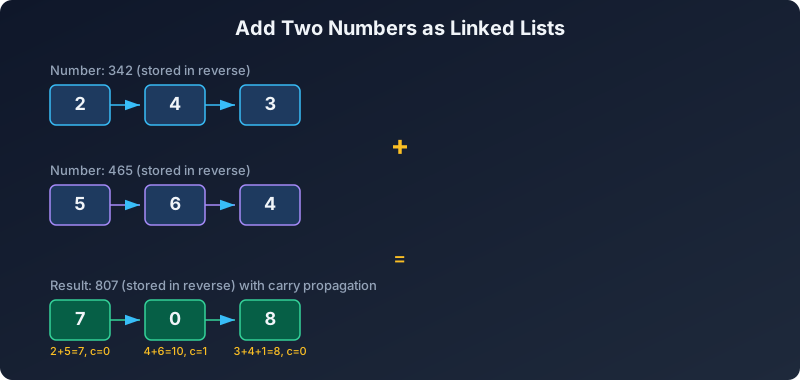
When you add two numbers by hand, you start from the least significant digit (the rightmost one) and work left, carrying over when the sum exceeds 9. A linked list that stores digits in reverse order mirrors this process perfectly — the head is the ones digit, the next node is the tens digit, and so on. Addition becomes a simple traversal.
But what if the digits are stored in forward order? Now the head is the most significant digit, and we can’t start adding from there. This variant requires a different strategy.
We’ll solve both versions in this article.
Part 1: Reverse order (LeetCode 2)
Problem statement
You are given two non-empty linked lists representing two non-negative integers. The digits are stored in reverse order, and each node contains a single digit. Add the two numbers and return the sum as a linked list (also in reverse order).
LeetCode 2 — Add Two Numbers
Example:
Input:
  l1: 2 -> 4 -> 3    (represents 342)
  l2: 5 -> 6 -> 4    (represents 465)

Output:
  7 -> 0 -> 8        (represents 807)

Because: 342 + 465 = 807
Why reverse order is convenient
When digits are stored in reverse order, the head of each list is the ones place — exactly where we start addition. We can traverse both lists left to right, adding corresponding digits and propagating the carry, building the result as we go.
  342 stored as: 2 -> 4 -> 3
  465 stored as: 5 -> 6 -> 4

  Addition (left to right on the lists):
    2 + 5 = 7,  carry = 0  =>  node 7
    4 + 6 = 10, carry = 1  =>  node 0
    3 + 4 + 1(carry) = 8   =>  node 8

  Result: 7 -> 0 -> 8  (which is 807)
Implementation
class ListNode:
    def __init__(self, val=0, next=None):
        self.val = val
        self.next = next


def add_two_numbers(l1: ListNode, l2: ListNode) -> ListNode:
    dummy = ListNode(0)
    current = dummy
    carry = 0

    while l1 or l2 or carry:
        # Get values (0 if the list is exhausted)
        val1 = l1.val if l1 else 0
        val2 = l2.val if l2 else 0

        # Compute sum and carry
        total = val1 + val2 + carry
        carry = total // 10
        digit = total % 10

        # Create new node
        current.next = ListNode(digit)
        current = current.next

        # Advance pointers
        if l1:
            l1 = l1.next
        if l2:
            l2 = l2.next

    return dummy.next
Detailed walkthrough
l1: 2 -> 4 -> 3
l2: 5 -> 6 -> 4

carry = 0, dummy -> ...

Iteration 1:
  val1=2, val2=5, carry=0
  total = 7, carry = 0, digit = 7
  dummy -> 7
  l1=4, l2=6

Iteration 2:
  val1=4, val2=6, carry=0
  total = 10, carry = 1, digit = 0
  dummy -> 7 -> 0
  l1=3, l2=4

Iteration 3:
  val1=3, val2=4, carry=1
  total = 8, carry = 0, digit = 8
  dummy -> 7 -> 0 -> 8
  l1=None, l2=None

Loop ends (l1=None, l2=None, carry=0)

Return: 7 -> 0 -> 8
Handling different lengths
l1: 9 -> 9 -> 9 -> 9    (represents 9999)
l2: 1                    (represents 1)

Iteration 1: 9+1+0 = 10, carry=1, digit=0
Iteration 2: 9+0+1 = 10, carry=1, digit=0  (l2 exhausted, treat as 0)
Iteration 3: 9+0+1 = 10, carry=1, digit=0
Iteration 4: 9+0+1 = 10, carry=1, digit=0
Iteration 5: 0+0+1 = 1,  carry=0, digit=1  (both exhausted, but carry remains)

Result: 0 -> 0 -> 0 -> 0 -> 1  (represents 10000)
The while l1 or l2 or carry condition is crucial — it handles the case where the final carry creates an extra digit.
Complexity
| Metric | Value |
|---|---|
| Time | O(max(m, n)) where m and n are the lengths of the two lists |
| Space | O(max(m, n)) for the result list (O(1) extra space beyond that) |
Part 2: Forward order (LeetCode 445)
Problem statement
Given two non-empty linked lists representing two non-negative integers where the most significant digit comes first, add the two numbers and return the sum as a linked list.
LeetCode 445 — Add Two Numbers II
Example:
Input:
  l1: 7 -> 2 -> 4 -> 3    (represents 7243)
  l2: 5 -> 6 -> 4          (represents 564)

Output:
  7 -> 8 -> 0 -> 7          (represents 7807)

Because: 7243 + 564 = 7807
The challenge
With forward-order storage, the heads are the most significant digits. We can’t add them first because we don’t know the carry from less significant positions yet.
Approach 1: Use stacks
Push all digits onto stacks, then pop and add (effectively processing in reverse). This is the most straightforward approach.
def add_two_numbers_ii_stack(l1: ListNode, l2: ListNode) -> ListNode:
    # Push all digits onto stacks
    stack1, stack2 = [], []

    while l1:
        stack1.append(l1.val)
        l1 = l1.next

    while l2:
        stack2.append(l2.val)
        l2 = l2.next

    carry = 0
    head = None

    while stack1 or stack2 or carry:
        val1 = stack1.pop() if stack1 else 0
        val2 = stack2.pop() if stack2 else 0

        total = val1 + val2 + carry
        carry = total // 10
        digit = total % 10

        # Build the result list from tail to head
        new_node = ListNode(digit)
        new_node.next = head
        head = new_node

    return head
Building the list from tail to head
Notice the key difference from Part 1. Instead of appending to a dummy’s tail, we prepend each new node to the head:
new_node = ListNode(digit)
new_node.next = head
head = new_node
This builds the result in forward order without needing to reverse it at the end.
Processing (from stacks):
  3+4 = 7, carry=0  =>  head = 7
  4+6 = 10, carry=1 =>  head = 0 -> 7
  2+5+1 = 8, carry=0 => head = 8 -> 0 -> 7
  7+0 = 7, carry=0  =>  head = 7 -> 8 -> 0 -> 7

Result: 7 -> 8 -> 0 -> 7
Complexity (stack approach)
| Metric | Value |
|---|---|
| Time | O(m + n) |
| Space | O(m + n) for the two stacks |
Approach 2: Reverse both lists first
If you want to avoid stacks, reverse both input lists, apply the Part 1 algorithm, then reverse the result.
def reverse_list(head: ListNode) -> ListNode:
    prev = None
    current = head
    while current:
        next_node = current.next
        current.next = prev
        prev = current
        current = next_node
    return prev


def add_two_numbers_ii_reverse(l1: ListNode, l2: ListNode) -> ListNode:
    # Reverse both lists
    l1 = reverse_list(l1)
    l2 = reverse_list(l2)

    # Use the same algorithm as LeetCode 2
    dummy = ListNode(0)
    current = dummy
    carry = 0

    while l1 or l2 or carry:
        val1 = l1.val if l1 else 0
        val2 = l2.val if l2 else 0

        total = val1 + val2 + carry
        carry = total // 10
        digit = total % 10

        current.next = ListNode(digit)
        current = current.next

        if l1:
            l1 = l1.next
        if l2:
            l2 = l2.next

    # Reverse the result to get forward order
    return reverse_list(dummy.next)
Complexity (reverse approach)
| Metric | Value |
|---|---|
| Time | O(m + n) — reverse O(m) + reverse O(n) + add O(max(m,n)) + reverse result |
| Space | O(max(m, n)) for the result only (O(1) extra space if we don’t count output) |
This approach modifies the input lists. If that’s not allowed, use the stack approach.
Comparison
| Approach | Problem | Time | Space | Modifies input? |
|---|---|---|---|---|
| Direct traversal | Reverse order (LC 2) | O(max(m,n)) | O(1) extra | No |
| Stack-based | Forward order (LC 445) | O(m+n) | O(m+n) | No |
| Reverse lists | Forward order (LC 445) | O(m+n) | O(1) extra | Yes |
Edge cases
Both lists are single nodes with large sum
l1: 5
l2: 5

5 + 5 = 10, carry = 1, digit = 0
Next iteration: carry = 1, digit = 1

Result: 0 -> 1  (reverse order) or 1 -> 0  (forward order)
One list is much longer
l1: 1 -> 0 -> 0 -> 0 -> 0    (10000)
l2: 1                          (1)

Reverse order: 0+1=1, 0+0=0, 0+0=0, 0+0=0, 1+0=1
Result: 1 -> 0 -> 0 -> 0 -> 1  (10001)
Carry cascades through the entire number
l1: 9 -> 9 -> 9    (999)
l2: 1              (1)

999 + 1 = 1000
Result (reverse): 0 -> 0 -> 0 -> 1
Common mistakes
-
Forgetting the final carry. If
l1 = [9]andl2 = [9], the result is[8, 1](reverse order). The loop condition must checkcarrytoo. -
Not handling different lengths. When one list runs out, treat its values as 0. Don’t stop the loop when the shorter list ends.
-
Forward-order confusion. Students often try to add forward-order lists left to right without accounting for carry direction. This doesn’t work — you must process least-significant digits first.
-
Modifying input lists unintentionally. The reverse approach changes the original lists. If the problem forbids modification, use stacks instead.
Practice problems
| Problem | Difficulty | Link |
|---|---|---|
| Add Two Numbers | Medium | LeetCode 2 |
| Add Two Numbers II | Medium | LeetCode 445 |
| Plus One Linked List | Medium | LeetCode 369 |
| Multiply Strings | Medium | LeetCode 43 |
| Add Binary | Easy | LeetCode 67 |
Key takeaways
- Reverse-order storage makes digit-by-digit addition natural — you process from head to tail, just like elementary school addition from right to left.
- Forward-order storage requires preprocessing: either use stacks to reverse the processing order or physically reverse the lists.
- The
while l1 or l2 or carrypattern is the standard idiom for this class of problems. It handles different lengths and final carries in a single, clean loop. - Building a result list from tail to head (prepending) is a useful technique when you need forward-order output but are processing in reverse.
Related articles
- DSA Copy Linked List with Random Pointer
Learn two approaches to deep copy a linked list with random pointers — HashMap O(n) space and the interleaving O(1) space technique. Step-by-step walkthroughs with Python code and Big-O analysis.
- DSA Flatten a Multilevel Linked List
Learn to flatten a multilevel doubly linked list (LeetCode 430) and flatten sorted linked lists. Covers iterative and recursive DFS approaches with Python implementations and Big-O analysis.
- DSA Linked List Palindrome Check: Three Approaches
Learn three ways to check if a linked list is a palindrome — stack-based O(n) space, reverse-second-half O(1) space, and recursive. Step-by-step walkthroughs with Python code and Big-O analysis.
- DSA Partition and Rearrange Linked Lists
Master linked list partitioning — partition around a value (LeetCode 86), odd-even rearrangement (LeetCode 328), segregate 0s/1s/2s, with full Python implementations and Big-O analysis.