Data Lakes vs Warehouses vs Lakehouses
Understand the differences between data lakes, data warehouses, and the modern lakehouse architecture — when to use each and how they work together.
What you'll learn
- ✓What data lakes, warehouses, and lakehouses are
- ✓The strengths and weaknesses of each architecture
- ✓How lakehouse table formats (Iceberg, Delta, Hudi) work
- ✓When to choose each pattern for your use case
- ✓How the three architectures work together in practice
Prerequisites
- •Basic understanding of databases and file storage
- •Familiarity with SQL and data pipelines
The data storage landscape has three major architectures. Each one emerged because the previous one could not solve every problem. Understanding when and why to use each is a core data engineering skill.
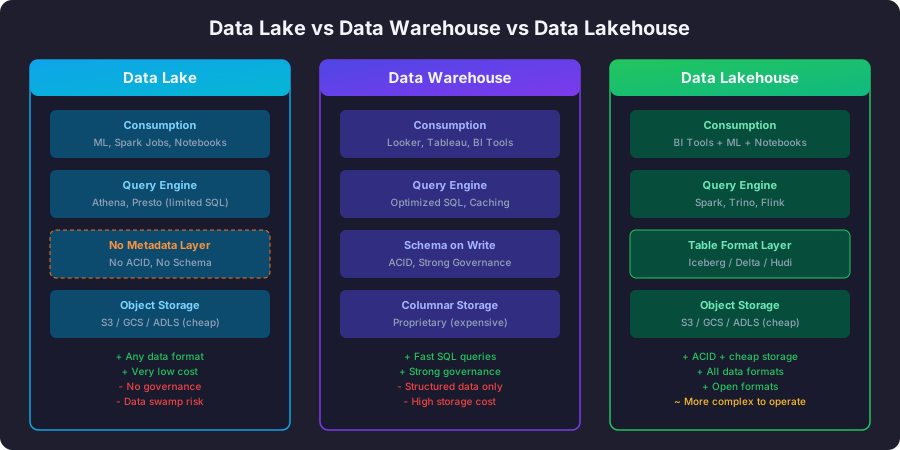
Data warehouse
A data warehouse is a structured, schema-on-write database optimized for analytical SQL queries.
How it works: data is cleaned, validated, and loaded into predefined schemas (star or snowflake). The warehouse enforces types, constraints, and structure at write time.
Strengths:
- Excellent SQL query performance — columnar storage, query optimization, caching.
- Strong governance — schema enforcement, access control, audit trails.
- BI tools integrate natively — Looker, Tableau, Metabase all expect a warehouse.
- ACID transactions — consistent reads, no partial writes.
Weaknesses:
- Structured data only — no images, logs, videos, or raw JSON blobs.
- Schema must be defined upfront — changes require migration.
- Expensive storage — warehouse storage costs 10-100x more than object storage.
- Not ideal for ML workloads — data scientists need raw, flexible data.
Popular warehouses: Snowflake, Google BigQuery, Amazon Redshift, Databricks SQL.
Data lake
A data lake is a centralized repository that stores raw data in its native format on cheap object storage (S3, GCS, Azure Blob).
How it works: everything gets dumped in — CSVs, JSON, Parquet, images, logs, API responses. Schema is applied at read time, not write time (schema-on-read).
Strengths:
- Stores any data type — structured, semi-structured, unstructured.
- Extremely cheap storage — S3 costs ~$0.023/GB/month vs $23+/TB/month for warehouses.
- Ideal for ML — data scientists can access raw data in any format.
- Flexible — no schema migration needed, store now and figure out structure later.
Weaknesses:
- No ACID transactions — concurrent reads/writes can produce inconsistent results.
- No schema enforcement — data quality degrades over time (“data swamp”).
- Poor query performance for SQL — scanning raw files is slow without optimization.
- Weak governance — hard to track lineage, enforce access, or audit usage.
Common implementations: S3 + Athena, GCS + BigQuery external tables, ADLS + Databricks.
The data swamp problem
Without governance, a data lake becomes a data swamp:
- Files with no documentation — nobody knows what
export_final_v2_FIXED.csvcontains. - Schema drift — the same file type has different column names across months.
- Stale data — files from 2019 sit next to files from today, all treated equally.
- No access control — sensitive PII mixed with public metrics.
- No lineage — impossible to trace where a number came from.
This is why the industry invented the lakehouse.
Data lakehouse
A lakehouse adds a metadata and transaction layer on top of a data lake, giving it warehouse-like capabilities while keeping the cheap storage and format flexibility of a lake.
How it works: data still lives as Parquet/ORC files on object storage. A table format layer (Delta Lake, Apache Iceberg, or Apache Hudi) adds ACID transactions, schema enforcement, time travel, and partition management on top of those files.
┌──────────────────────────────────────┐
│        Query Engines                  │
│   Spark / Trino / Presto / Flink     │
└────────────────┬─────────────────────┘
                 │
┌────────────────▼─────────────────────┐
│        Table Format Layer             │
│   Delta Lake / Iceberg / Hudi         │
│   (ACID, Schema, Time Travel)         │
└────────────────┬─────────────────────┘
                 │
┌────────────────▼─────────────────────┐
│        Object Storage                 │
│   S3 / GCS / ADLS                     │
│   (Parquet files)                     │
└──────────────────────────────────────┘
Strengths:
- ACID transactions on cheap object storage.
- Schema enforcement with evolution (add columns without rewriting).
- Time travel — query data as it existed at any past point.
- Works for both SQL analytics and ML workloads.
- Open formats — no vendor lock-in, multiple engines can read the same tables.
Weaknesses:
- More complex to operate than a managed warehouse.
- Query performance still lags behind purpose-built warehouses for complex SQL.
- Ecosystem is younger — tooling gaps compared to mature warehouse platforms.
Table format comparison
| Feature | Delta Lake | Apache Iceberg | Apache Hudi |
|---|---|---|---|
| Creator | Databricks | Netflix | Uber |
| ACID | Yes | Yes | Yes |
| Time travel | Yes | Yes | Yes |
| Schema evolution | Yes | Yes (best) | Yes |
| Partition evolution | Limited | Yes (hidden partitions) | Limited |
| Engine support | Spark-first | Multi-engine (Spark, Trino, Flink) | Spark, Flink |
| Upserts | MERGE | MERGE | Native (optimized for CDC) |
| Ecosystem | Databricks-centric | Vendor-neutral | Smaller community |
Apache Iceberg has the broadest engine support and best partition evolution. Delta Lake has the deepest Databricks integration. Apache Hudi was purpose-built for change data capture (CDC) and incremental processing.
Side-by-side comparison
| Feature | Data Warehouse | Data Lake | Data Lakehouse |
|---|---|---|---|
| Data types | Structured only | All types | All types |
| Schema | On-write | On-read | Both |
| ACID | Yes | No | Yes |
| Storage cost | High | Low | Low |
| Query performance | Excellent | Variable | Good |
| Governance | Strong | Weak | Strong |
| ML support | Limited | Excellent | Excellent |
| Best for | BI / Reporting | Raw storage / ML | Unified analytics |
When to use each
Use a warehouse when:
- Your team is SQL-first and BI-focused.
- You want a managed service with minimal operations overhead.
- Data is structured and schema changes are infrequent.
- Budget allows warehouse storage costs.
Use a data lake when:
- You need to store raw, unstructured data (images, logs, videos).
- Cost is the primary concern and you have petabytes of data.
- ML teams need flexible access to raw data.
- You are building a staging area for an ELT pipeline.
Use a lakehouse when:
- You want the flexibility of a lake with the governance of a warehouse.
- Both analytics and ML teams need to work from the same data.
- You need ACID transactions on large-scale data.
- You want to avoid vendor lock-in with open table formats.
The practical reality
Most organizations use a combination:
- Data lake — raw landing zone where all source data arrives.
- Lakehouse layer — Iceberg or Delta on top of the lake for curated, governed tables.
- Data warehouse — Snowflake or BigQuery for the final analytics-ready layer consumed by BI tools.
The three architectures are not competitors. They are layers in a modern data platform.
Next steps
- Data Warehouse Concepts — star schemas and dimensional modeling.
- Batch vs Stream Processing — how data moves between these layers.
- What Is Apache Kafka? — real-time data streaming into lakes and warehouses.
Related articles
- Data Engineering Data Warehouse Concepts: Star Schema and Beyond
Learn the fundamentals of data warehousing — star schemas, snowflake schemas, fact tables, dimension tables, and slowly changing dimensions with examples.
- Data Engineering Apache Spark Fundamentals — Big Data Processing at Scale
Learn Apache Spark: RDDs, DataFrames, SparkSQL, the execution model, PySpark basics, platform comparisons, and essential performance optimization tips.
- Data Engineering Data Observability — Monitoring Your Data, Not Just Pipes
Learn the five pillars of data observability, anomaly detection, lineage tracking, incident response, and tools like Elementary, Monte Carlo, and Soda.
- Data Engineering CI/CD for Data Pipelines — Ship Data with Confidence
Build CI/CD workflows for data pipelines: lint SQL, validate DAGs, run tests, deploy dbt models, and manage dev/staging/prod environments.