Hash Map Internals: How Hash Tables Really Work
Deep dive into hash map internals -- hash functions, collision resolution (chaining vs open addressing), load factor, rehashing, and building a hash map from scratch in Python.
What you'll learn
- ✓How hash functions map keys to bucket indices
- ✓Collision resolution: separate chaining vs open addressing
- ✓Load factor, rehashing, and amortized O(1) operations
- ✓How Python dicts work internally (open addressing with probing)
- ✓Building a hash map from scratch in Python
- ✓Robin Hood hashing and other advanced techniques
Prerequisites
- •Basic understanding of Arrays and linked lists
- •Familiar with Big-O Notation
What is a Hash Map?
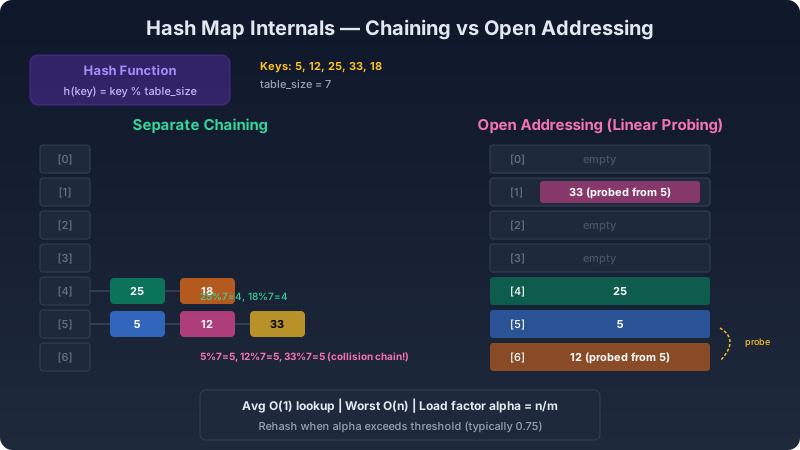
A hash map (or hash table) is a data structure that maps keys to values using a hash function. The hash function converts a key into an array index (bucket), allowing average O(1) lookups, insertions, and deletions.
The core idea is simple:
- Given a key, compute
hash(key) % table_sizeto get a bucket index. - Store the key-value pair in that bucket.
- On lookup, compute the same hash and go directly to the bucket.
The challenge is handling collisions — when two different keys hash to the same bucket.
Hash Functions
What Makes a Good Hash Function?
A good hash function should:
- Distribute keys uniformly across buckets (minimize clustering)
- Be deterministic — same key always produces the same hash
- Be fast to compute
- Minimize collisions — different keys should rarely hash to the same value
Common Hash Functions
def hash_division(key, table_size):
    """Simple division method: h(k) = k mod m."""
    return key % table_size

def hash_multiplication(key, table_size):
    """Multiplication method (Knuth's)."""
    A = 0.6180339887  # (sqrt(5) - 1) / 2
    return int(table_size * ((key * A) % 1))

def hash_string(s, table_size):
    """Polynomial rolling hash for strings."""
    h = 0
    base = 31
    for ch in s:
        h = (h * base + ord(ch)) % table_size
    return h
Python’s Built-in hash()
Python uses different hash functions depending on the type:
- Integers: The hash of a small integer is the integer itself.
- Strings: SipHash (cryptographic, collision-resistant).
- Tuples: Combines hashes of elements.
# Python's hash is randomized per process for strings (security)
print(hash(42))        # 42
print(hash("hello"))   # Different each run
print(hash((1, 2, 3))) # Depends on element hashes
Collision Resolution: Separate Chaining
Separate chaining stores a linked list (or other collection) at each bucket. When a collision occurs, the new element is appended to the list.
class HashMapChaining:
    """Hash map using separate chaining for collision resolution."""

    def __init__(self, initial_capacity=16, load_factor_threshold=0.75):
        self.capacity = initial_capacity
        self.load_factor_threshold = load_factor_threshold
        self.size = 0
        self.buckets = [[] for _ in range(self.capacity)]

    def _hash(self, key):
        """Compute bucket index for the given key."""
        return hash(key) % self.capacity

    def put(self, key, value):
        """Insert or update a key-value pair."""
        idx = self._hash(key)

        # Check if key already exists
        for i, (k, v) in enumerate(self.buckets[idx]):
            if k == key:
                self.buckets[idx][i] = (key, value)
                return

        # Key not found, append
        self.buckets[idx].append((key, value))
        self.size += 1

        # Check load factor and rehash if needed
        if self.size / self.capacity > self.load_factor_threshold:
            self._rehash()

    def get(self, key, default=None):
        """Retrieve value for the given key."""
        idx = self._hash(key)
        for k, v in self.buckets[idx]:
            if k == key:
                return v
        return default

    def remove(self, key):
        """Remove a key-value pair. Returns True if found."""
        idx = self._hash(key)
        for i, (k, v) in enumerate(self.buckets[idx]):
            if k == key:
                self.buckets[idx].pop(i)
                self.size -= 1
                return True
        return False

    def _rehash(self):
        """Double the capacity and rehash all elements."""
        old_buckets = self.buckets
        self.capacity *= 2
        self.buckets = [[] for _ in range(self.capacity)]
        self.size = 0

        for bucket in old_buckets:
            for key, value in bucket:
                self.put(key, value)

    def __contains__(self, key):
        return self.get(key) is not None

    def __len__(self):
        return self.size

    def __repr__(self):
        items = []
        for bucket in self.buckets:
            for k, v in bucket:
                items.append(f"{k}: {v}")
        return "{" + ", ".join(items) + "}"


# Usage
hm = HashMapChaining()
hm.put("apple", 1)
hm.put("banana", 2)
hm.put("cherry", 3)
print(hm.get("banana"))    # 2
print("apple" in hm)       # True
hm.remove("banana")
print(hm.get("banana"))    # None
print(f"Size: {len(hm)}")  # 2
Collision Resolution: Open Addressing
In open addressing, all elements are stored directly in the table array. When a collision occurs, we probe (search for) the next available slot.
Linear Probing
class HashMapLinearProbing:
    """Hash map using open addressing with linear probing."""

    EMPTY = object()     # Sentinel for empty slots
    DELETED = object()   # Sentinel for deleted slots (tombstone)

    def __init__(self, initial_capacity=16, load_factor_threshold=0.5):
        self.capacity = initial_capacity
        self.load_factor_threshold = load_factor_threshold
        self.size = 0
        self.keys = [self.EMPTY] * self.capacity
        self.values = [None] * self.capacity

    def _hash(self, key):
        return hash(key) % self.capacity

    def _probe(self, key):
        """Find the slot for this key (existing or empty)."""
        idx = self._hash(key)
        first_deleted = -1

        for _ in range(self.capacity):
            if self.keys[idx] is self.EMPTY:
                # Empty slot: key doesn't exist
                return first_deleted if first_deleted != -1 else idx
            elif self.keys[idx] is self.DELETED:
                if first_deleted == -1:
                    first_deleted = idx
            elif self.keys[idx] == key:
                return idx

            idx = (idx + 1) % self.capacity  # Linear probe

        return first_deleted if first_deleted != -1 else -1

    def put(self, key, value):
        idx = self._probe(key)
        if idx == -1:
            self._rehash()
            idx = self._probe(key)

        is_new = self.keys[idx] is self.EMPTY or self.keys[idx] is self.DELETED
        self.keys[idx] = key
        self.values[idx] = value

        if is_new:
            self.size += 1
            if self.size / self.capacity > self.load_factor_threshold:
                self._rehash()

    def get(self, key, default=None):
        idx = self._hash(key)
        for _ in range(self.capacity):
            if self.keys[idx] is self.EMPTY:
                return default
            if self.keys[idx] == key:
                return self.values[idx]
            idx = (idx + 1) % self.capacity
        return default

    def remove(self, key):
        idx = self._hash(key)
        for _ in range(self.capacity):
            if self.keys[idx] is self.EMPTY:
                return False
            if self.keys[idx] == key:
                self.keys[idx] = self.DELETED  # Tombstone
                self.values[idx] = None
                self.size -= 1
                return True
            idx = (idx + 1) % self.capacity
        return False

    def _rehash(self):
        old_keys = self.keys
        old_values = self.values
        self.capacity *= 2
        self.keys = [self.EMPTY] * self.capacity
        self.values = [None] * self.capacity
        self.size = 0

        for i in range(len(old_keys)):
            if old_keys[i] is not self.EMPTY and old_keys[i] is not self.DELETED:
                self.put(old_keys[i], old_values[i])

    def __len__(self):
        return self.size


# Usage
hm = HashMapLinearProbing()
for i in range(100):
    hm.put(f"key_{i}", i * 10)

print(hm.get("key_42"))    # 420
print(hm.get("key_99"))    # 990
print(len(hm))             # 100
Quadratic Probing
Instead of probing (h + 1), (h + 2), (h + 3), ... we probe (h + 1), (h + 4), (h + 9), ...:
def quadratic_probe(self, key):
    idx = self._hash(key)
    i = 0
    while True:
        slot = (idx + i * i) % self.capacity
        if self.keys[slot] is self.EMPTY or self.keys[slot] == key:
            return slot
        i += 1
Quadratic probing avoids the primary clustering problem of linear probing, where consecutive occupied slots form long chains.
Double Hashing
Use a second hash function to determine the probe step:
def double_hash_probe(self, key):
    h1 = hash(key) % self.capacity
    h2 = 1 + (hash(key) % (self.capacity - 1))  # Must be non-zero

    i = 0
    while True:
        slot = (h1 + i * h2) % self.capacity
        if self.keys[slot] is self.EMPTY or self.keys[slot] == key:
            return slot
        i += 1
Load Factor and Rehashing
The load factor alpha = n / m (number of elements / table size) determines performance:
| Load Factor | Chaining Avg Probe | Linear Probing Avg Probe |
|---|---|---|
| 0.25 | 1.25 | 1.17 |
| 0.50 | 1.50 | 1.50 |
| 0.75 | 1.75 | 2.50 |
| 0.90 | 1.90 | 5.50 |
| 0.95 | 1.95 | 10.50 |
For chaining, average chain length = alpha, so lookups take O(1 + alpha).
For linear probing, performance degrades rapidly above alpha = 0.75.
Rehashing (doubling the table and reinserting all elements) is triggered when the load factor exceeds a threshold. While a single rehash takes O(n), it happens infrequently enough that the amortized cost per insertion remains O(1).
def analyze_load_factor():
    """Demonstrate how load factor affects collision rate."""
    import random

    for load in [0.25, 0.50, 0.75, 0.90]:
        table_size = 1000
        n = int(table_size * load)

        buckets = [0] * table_size
        for _ in range(n):
            idx = random.randint(0, table_size - 1)
            buckets[idx] += 1

        collisions = sum(1 for b in buckets if b > 1)
        max_chain = max(buckets)
        empty = sum(1 for b in buckets if b == 0)

        print(f"Load={load:.2f}: collisions={collisions}, "
              f"max_chain={max_chain}, empty_buckets={empty}")

analyze_load_factor()
How Python’s dict Works
Python’s dict uses open addressing with a custom probing scheme:
- Table size is always a power of 2.
- Hash function: SipHash for strings, identity for small ints.
- Probing: A perturbation-based scheme that uses the full hash value (not just
hash % size). - Load factor threshold: 2/3 (approximately 0.67).
- Compact dict (Python 3.6+): Separates the hash table from the insertion-order list, saving memory and preserving insertion order.
import sys

# Python dict memory usage
d = {}
print(f"Empty dict: {sys.getsizeof(d)} bytes")  # ~64 bytes

for i in range(100):
    d[i] = i
print(f"100-element dict: {sys.getsizeof(d)} bytes")  # ~4192 bytes

# dict preserves insertion order (guaranteed since Python 3.7)
d = {"c": 3, "a": 1, "b": 2}
print(list(d.keys()))  # ['c', 'a', 'b']
Python’s Probe Sequence
# Simplified version of CPython's probe sequence
def python_probe(hash_val, table_size):
    """Simulate Python's perturbation-based probing."""
    PERTURB_SHIFT = 5
    perturb = hash_val
    idx = hash_val % table_size

    indices = [idx]
    for _ in range(10):
        perturb >>= PERTURB_SHIFT
        idx = (5 * idx + perturb + 1) % table_size
        indices.append(idx)

    return indices

# Shows that the probe sequence visits many different parts of the table
print(python_probe(42, 32))
Robin Hood Hashing
Robin Hood hashing is an open addressing variant that reduces the variance of probe lengths. The idea: when inserting, if the current element has traveled fewer steps from its home slot than the element already there, swap them (steal from the rich, give to the poor).
class RobinHoodHashMap:
    """Hash map using Robin Hood hashing."""

    EMPTY = object()

    def __init__(self, capacity=16):
        self.capacity = capacity
        self.size = 0
        self.keys = [self.EMPTY] * capacity
        self.values = [None] * capacity
        self.distances = [0] * capacity  # How far each element is from home

    def _hash(self, key):
        return hash(key) % self.capacity

    def put(self, key, value):
        if self.size / self.capacity > 0.5:
            self._rehash()

        idx = self._hash(key)
        dist = 0

        while True:
            if self.keys[idx] is self.EMPTY:
                self.keys[idx] = key
                self.values[idx] = value
                self.distances[idx] = dist
                self.size += 1
                return

            if self.keys[idx] == key:
                self.values[idx] = value
                return

            # Robin Hood: if current element is "richer" (shorter distance),
            # swap and continue inserting the displaced element
            if self.distances[idx] < dist:
                # Swap
                key, self.keys[idx] = self.keys[idx], key
                value, self.values[idx] = self.values[idx], value
                dist, self.distances[idx] = self.distances[idx], dist

            idx = (idx + 1) % self.capacity
            dist += 1

    def get(self, key, default=None):
        idx = self._hash(key)
        dist = 0

        while True:
            if self.keys[idx] is self.EMPTY:
                return default
            if self.keys[idx] == key:
                return self.values[idx]
            # If we've probed further than this element's distance,
            # the key doesn't exist (Robin Hood invariant)
            if self.distances[idx] < dist:
                return default

            idx = (idx + 1) % self.capacity
            dist += 1

    def _rehash(self):
        old_keys = self.keys
        old_values = self.values
        self.capacity *= 2
        self.keys = [self.EMPTY] * self.capacity
        self.values = [None] * self.capacity
        self.distances = [0] * self.capacity
        self.size = 0

        for i in range(len(old_keys)):
            if old_keys[i] is not self.EMPTY:
                self.put(old_keys[i], old_values[i])


# Usage
rh = RobinHoodHashMap()
for i in range(50):
    rh.put(f"key_{i}", i)

print(rh.get("key_25"))  # 25
print(rh.get("key_49"))  # 49
print(rh.get("missing")) # None
The key benefit: Robin Hood hashing gives very low variance in probe lengths. The maximum probe length is O(log n) with high probability, compared to O(log n / log log n) expected for linear probing.
Time Complexity Analysis
| Operation | Average | Worst Case | Amortized (with rehashing) |
|---|---|---|---|
| Insert | O(1) | O(n) | O(1) |
| Lookup | O(1) | O(n) | O(1) |
| Delete | O(1) | O(n) | O(1) |
The worst case O(n) happens when all keys hash to the same bucket. With a good hash function, this is extremely unlikely.
When O(1) Becomes O(n)
# Adversarial example: all keys hash to same bucket
class BadHash:
    def __init__(self, val):
        self.val = val
    def __hash__(self):
        return 42  # Everything hashes to 42!
    def __eq__(self, other):
        return isinstance(other, BadHash) and self.val == other.val

# This creates a hash table that degrades to a linked list
d = {}
for i in range(1000):
    d[BadHash(i)] = i
# Lookups are now O(n)
Chaining vs Open Addressing: When to Use Which
| Feature | Chaining | Open Addressing |
|---|---|---|
| Load factor | Can exceed 1.0 | Must stay below ~0.75 |
| Memory | Extra pointers | No extra pointers |
| Cache performance | Poor (linked list) | Good (array) |
| Deletion | Simple | Needs tombstones |
| Implementation | Simpler | More complex |
| Used by | Java HashMap | Python dict, Rust HashMap |
Practice Problems
- Design HashMap (LeetCode 706) — Implement basic put, get, remove.
- Two Sum (LeetCode 1) — Classic hash map application.
- Group Anagrams (LeetCode 49) — Hash map with sorted string keys.
- LRU Cache (LeetCode 146) — Hash map + doubly linked list.
- Longest Consecutive Sequence (LeetCode 128) — Hash set for O(n) solution.
- Subarray Sum Equals K (LeetCode 560) — Prefix sum + hash map.
Key Takeaways
- Hash maps achieve average O(1) operations by computing a bucket index directly from the key.
- Separate chaining stores collisions in linked lists; open addressing probes for the next empty slot.
- The load factor determines performance; rehashing keeps it low at the cost of occasional O(n) resizes.
- Python’s
dictuses open addressing with perturbation-based probing and a 2/3 load factor threshold. - Robin Hood hashing reduces probe length variance by swapping elements during insertion.
- Always use a good hash function to ensure uniform distribution; a bad hash degrades everything to O(n).
Related articles
- DSA BFS Pattern with Queues: Level-Order and Shortest Path
Master BFS using queues for tree level-order traversal and shortest path in unweighted graphs. Python implementations with detailed traces.
- DSA Design Circular Deque — Array-Based Implementation (LeetCode 641)
Design a Circular Deque with front/rear pointers on a fixed-size array. Python solution with all O(1) operations, visual trace, and edge case handling.
- DSA Design Hit Counter Using Queue
Design a hit counter that counts hits in the past 5 minutes using a queue. LeetCode 362 solution with O(1) amortized operations.
- DSA First Non-Repeating Character in a Stream
Find the first non-repeating character in a character stream using a queue and hash map. Python solution with O(1) amortized per query.