Two Pointer: Advanced Patterns and Templates
Master opposite-direction, same-direction, and fast-slow two pointer patterns. Includes templates, container with most water, cycle detection, and sort colors.
What you'll learn
- ✓Three fundamental two-pointer patterns and when to use each
- ✓Opposite-direction for sorted arrays and palindromes
- ✓Same-direction for in-place array modifications
- ✓Fast-slow pointer for cycle detection and linked list middle
- ✓Three-pointer Dutch national flag (sort colors)
Prerequisites
- •Arrays: [Arrays Introduction](/blog/arrays-introduction)
- •Linked Lists: [Linked List Introduction](/blog/linked-list-introduction)
- •Big-O: [Big-O Notation Explained](/blog/big-o-notation-explained)
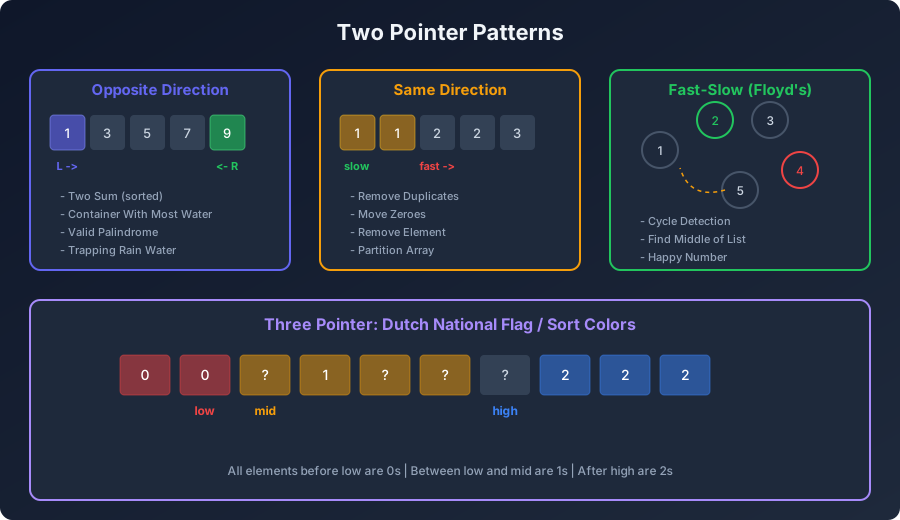
The two-pointer technique is one of the most versatile tools in your DSA toolkit. Instead of brute-forcing with nested loops (O(n^2)), two pointers often reduce the problem to a single pass (O(n)). The key is recognizing which pattern to apply.
Pattern 1: opposite direction
Two pointers start at opposite ends and move toward each other. This works on sorted arrays or when you need to compare elements from both ends.
Template
def opposite_direction(arr):
    left, right = 0, len(arr) - 1
    while left < right:
        # Process arr[left] and arr[right]
        if condition_met(arr[left], arr[right]):
            # Record answer
            left += 1   # or right -= 1, or both
        elif need_larger:
            left += 1
        else:
            right -= 1
Two sum (sorted array)
def two_sum_sorted(numbers, target):
    """
    Find two numbers that add up to target in a sorted array.
    Time: O(n), Space: O(1)
    """
    left, right = 0, len(numbers) - 1

    while left < right:
        current_sum = numbers[left] + numbers[right]

        if current_sum == target:
            return [left + 1, right + 1]  # 1-indexed
        elif current_sum < target:
            left += 1    # Need a larger sum
        else:
            right -= 1   # Need a smaller sum

    return []


print(two_sum_sorted([2, 7, 11, 15], 9))   # [1, 2]
print(two_sum_sorted([2, 3, 4], 6))         # [1, 3]
Why it works: Since the array is sorted, moving left right increases
the sum, and moving right left decreases it. This gives us directed
search instead of checking all pairs.
Container with most water
def max_area(height):
    """
    Find two lines that form a container holding the most water.
    Time: O(n), Space: O(1)
    """
    left, right = 0, len(height) - 1
    best = 0

    while left < right:
        width = right - left
        h = min(height[left], height[right])
        best = max(best, width * h)

        # Move the shorter line inward
        # Moving the taller line can never increase area
        # because height is limited by the shorter line
        if height[left] < height[right]:
            left += 1
        else:
            right -= 1

    return best


print(max_area([1, 8, 6, 2, 5, 4, 8, 3, 7]))  # 49
Key insight: Always move the pointer at the shorter line. The width decreases by 1 each step, so the only way to get more area is a taller minimum height.
Valid palindrome
def is_palindrome(s):
    """
    Check if string is a palindrome, ignoring non-alphanumeric.
    Time: O(n), Space: O(1)
    """
    left, right = 0, len(s) - 1

    while left < right:
        while left < right and not s[left].isalnum():
            left += 1
        while left < right and not s[right].isalnum():
            right -= 1

        if s[left].lower() != s[right].lower():
            return False

        left += 1
        right -= 1

    return True


print(is_palindrome("A man, a plan, a canal: Panama"))  # True
print(is_palindrome("race a car"))                       # False
Trapping rain water
def trap(height):
    """
    Calculate trapped rainwater using two pointers.
    Time: O(n), Space: O(1)
    """
    if not height:
        return 0

    left, right = 0, len(height) - 1
    left_max, right_max = height[left], height[right]
    water = 0

    while left < right:
        if left_max < right_max:
            left += 1
            left_max = max(left_max, height[left])
            water += left_max - height[left]
        else:
            right -= 1
            right_max = max(right_max, height[right])
            water += right_max - height[right]

    return water


print(trap([0, 1, 0, 2, 1, 0, 1, 3, 2, 1, 2, 1]))  # 6
Why two pointers work here: Water at any position depends on the minimum of the maximum heights on both sides. We track running maximums from each end and process the side with the smaller maximum, since that side determines the water level.
Three sum
def three_sum(nums):
    """
    Find all unique triplets that sum to zero.
    Time: O(n^2), Space: O(1) extra
    """
    nums.sort()
    result = []

    for i in range(len(nums) - 2):
        # Skip duplicates for first element
        if i > 0 and nums[i] == nums[i - 1]:
            continue

        left, right = i + 1, len(nums) - 1
        target = -nums[i]

        while left < right:
            current = nums[left] + nums[right]
            if current == target:
                result.append([nums[i], nums[left], nums[right]])
                # Skip duplicates
                while left < right and nums[left] == nums[left + 1]:
                    left += 1
                while left < right and nums[right] == nums[right - 1]:
                    right -= 1
                left += 1
                right -= 1
            elif current < target:
                left += 1
            else:
                right -= 1

    return result


print(three_sum([-1, 0, 1, 2, -1, -4]))
# [[-1, -1, 2], [-1, 0, 1]]
Pattern 2: same direction (slow-fast)
Both pointers move in the same direction, but at different speeds or conditions. The slow pointer marks the position for the next valid element, while the fast pointer scans ahead.
Template
def same_direction(arr):
    slow = 0
    for fast in range(len(arr)):
        if should_keep(arr[fast]):
            arr[slow] = arr[fast]
            slow += 1
    return slow  # New length
Remove duplicates from sorted array
def remove_duplicates(nums):
    """
    Remove duplicates in-place, return new length.
    Time: O(n), Space: O(1)
    """
    if not nums:
        return 0

    slow = 0
    for fast in range(1, len(nums)):
        if nums[fast] != nums[slow]:
            slow += 1
            nums[slow] = nums[fast]

    return slow + 1


nums = [0, 0, 1, 1, 1, 2, 2, 3, 3, 4]
length = remove_duplicates(nums)
print(f"Length: {length}, Array: {nums[:length]}")
# Length: 5, Array: [0, 1, 2, 3, 4]
Remove duplicates allowing at most K
def remove_duplicates_k(nums, k=2):
    """
    Allow at most k occurrences of each element.
    Time: O(n), Space: O(1)
    """
    if len(nums) <= k:
        return len(nums)

    slow = k
    for fast in range(k, len(nums)):
        if nums[fast] != nums[slow - k]:
            nums[slow] = nums[fast]
            slow += 1

    return slow


nums = [1, 1, 1, 2, 2, 3]
length = remove_duplicates_k(nums, k=2)
print(f"Length: {length}, Array: {nums[:length]}")
# Length: 5, Array: [1, 1, 2, 2, 3]
Move zeroes
def move_zeroes(nums):
    """
    Move all zeroes to the end while maintaining order.
    Time: O(n), Space: O(1)
    """
    slow = 0
    for fast in range(len(nums)):
        if nums[fast] != 0:
            nums[slow], nums[fast] = nums[fast], nums[slow]
            slow += 1


nums = [0, 1, 0, 3, 12]
move_zeroes(nums)
print(nums)  # [1, 3, 12, 0, 0]
Remove element
def remove_element(nums, val):
    """
    Remove all occurrences of val in-place.
    Time: O(n), Space: O(1)
    """
    slow = 0
    for fast in range(len(nums)):
        if nums[fast] != val:
            nums[slow] = nums[fast]
            slow += 1
    return slow


nums = [3, 2, 2, 3]
length = remove_element(nums, 3)
print(f"Length: {length}, Array: {nums[:length]}")
# Length: 2, Array: [2, 2]
Pattern 3: fast-slow (Floyd’s)
Two pointers move at different speeds through a linked list or sequence. The fast pointer moves 2 steps while the slow pointer moves 1 step.
Detect cycle in linked list
class ListNode:
    def __init__(self, val=0, next=None):
        self.val = val
        self.next = next


def has_cycle(head):
    """
    Floyd's cycle detection algorithm.
    Time: O(n), Space: O(1)
    """
    slow = fast = head

    while fast and fast.next:
        slow = slow.next
        fast = fast.next.next

        if slow == fast:
            return True

    return False
Why it works: If there is a cycle, the fast pointer enters the cycle first and laps the slow pointer. Since fast gains one position per step, they must eventually meet. If there is no cycle, fast reaches the end.
Find the start of a cycle
def detect_cycle(head):
    """
    Find the node where the cycle begins.
    Time: O(n), Space: O(1)
    """
    slow = fast = head

    # Phase 1: detect cycle
    while fast and fast.next:
        slow = slow.next
        fast = fast.next.next
        if slow == fast:
            break
    else:
        return None  # No cycle

    # Phase 2: find cycle start
    # Move one pointer back to head
    # Both advance one step at a time
    slow = head
    while slow != fast:
        slow = slow.next
        fast = fast.next

    return slow  # Cycle start
Math behind it: Let the distance from head to cycle start be a, cycle
length be c, and the meeting point be b steps into the cycle. Fast
traveled a + b + k*c and slow traveled a + b. Since fast moves twice
as fast: 2(a + b) = a + b + k*c, so a + b = k*c, meaning
a = k*c - b. Starting from the meeting point and advancing a steps
lands at the cycle start.
Find middle of linked list
def find_middle(head):
    """
    Find the middle node. For even-length lists,
    returns the second middle node.
    Time: O(n), Space: O(1)
    """
    slow = fast = head

    while fast and fast.next:
        slow = slow.next
        fast = fast.next.next

    return slow
Happy number
def is_happy(n):
    """
    A happy number eventually reaches 1 when you repeatedly
    replace it with the sum of squares of its digits.
    Uses Floyd's cycle detection.
    Time: O(log n), Space: O(1)
    """
    def get_next(num):
        total = 0
        while num > 0:
            digit = num % 10
            total += digit * digit
            num //= 10
        return total

    slow = n
    fast = get_next(n)

    while fast != 1 and slow != fast:
        slow = get_next(slow)
        fast = get_next(get_next(fast))

    return fast == 1


print(is_happy(19))  # True (19->82->68->100->1)
print(is_happy(2))   # False (enters cycle)
Pattern 4: three pointers (Dutch National Flag)
The Dutch National Flag algorithm uses three pointers to partition an array into three sections in a single pass.
Sort colors
def sort_colors(nums):
    """
    Sort array of 0s, 1s, and 2s in-place.
    Dutch National Flag algorithm.
    Time: O(n), Space: O(1)

    Invariants:
    - [0, low): all 0s
    - [low, mid): all 1s
    - [mid, high]: unprocessed
    - (high, n): all 2s
    """
    low, mid, high = 0, 0, len(nums) - 1

    while mid <= high:
        if nums[mid] == 0:
            nums[low], nums[mid] = nums[mid], nums[low]
            low += 1
            mid += 1
        elif nums[mid] == 1:
            mid += 1
        else:  # nums[mid] == 2
            nums[mid], nums[high] = nums[high], nums[mid]
            high -= 1
            # Don't increment mid - need to check swapped element


nums = [2, 0, 2, 1, 1, 0]
sort_colors(nums)
print(nums)  # [0, 0, 1, 1, 2, 2]
Why mid does not increment when swapping with high: The element swapped
from position high has not been examined yet. It could be 0, 1, or 2, so
we must check it before moving on.
Partition array around pivot
def partition_three_way(arr, pivot):
    """
    Partition array into elements < pivot, == pivot, > pivot.
    Time: O(n), Space: O(1)
    """
    low, mid, high = 0, 0, len(arr) - 1

    while mid <= high:
        if arr[mid] < pivot:
            arr[low], arr[mid] = arr[mid], arr[low]
            low += 1
            mid += 1
        elif arr[mid] == pivot:
            mid += 1
        else:
            arr[mid], arr[high] = arr[high], arr[mid]
            high -= 1

    return arr


print(partition_three_way([3, 5, 2, 7, 1, 5, 8, 5], 5))
# Elements < 5, then 5s, then > 5
Choosing the right pattern
| Scenario | Pattern | Examples |
|---|---|---|
| Sorted array, find pair | Opposite direction | Two Sum, 3Sum |
| Compare from both ends | Opposite direction | Palindrome, Container |
| In-place removal/dedup | Same direction | Remove duplicates, Move zeroes |
| Linked list cycle | Fast-slow | Cycle detection, Find middle |
| 3-way partition | Three pointers | Sort colors, DNF |
| Subsequence check | Same direction | Is Subsequence |
Advanced: merge two sorted arrays in-place
def merge_sorted(nums1, m, nums2, n):
    """
    Merge nums2 into nums1 (which has extra space at the end).
    Use opposite-direction from the END to avoid overwriting.
    Time: O(m + n), Space: O(1)
    """
    p1, p2, p = m - 1, n - 1, m + n - 1

    while p1 >= 0 and p2 >= 0:
        if nums1[p1] > nums2[p2]:
            nums1[p] = nums1[p1]
            p1 -= 1
        else:
            nums1[p] = nums2[p2]
            p2 -= 1
        p -= 1

    # Copy remaining elements from nums2
    nums1[:p2 + 1] = nums2[:p2 + 1]


nums1 = [1, 2, 3, 0, 0, 0]
merge_sorted(nums1, 3, [2, 5, 6], 3)
print(nums1)  # [1, 2, 2, 3, 5, 6]
Complexity summary
| Problem | Brute Force | Two Pointer |
|---|---|---|
| Two Sum (sorted) | O(n^2) | O(n) |
| Container With Most Water | O(n^2) | O(n) |
| Three Sum | O(n^3) | O(n^2) |
| Remove Duplicates | O(n) extra space | O(1) space |
| Cycle Detection | O(n) space (hash set) | O(1) space |
| Sort Colors | O(n log n) general sort | O(n) single pass |
| Trapping Rain Water | O(n) with extra arrays | O(1) space |
Practice problems
| Problem | Pattern | Difficulty |
|---|---|---|
| Two Sum II (LC 167) | Opposite | Easy |
| Valid Palindrome (LC 125) | Opposite | Easy |
| Move Zeroes (LC 283) | Same direction | Easy |
| Remove Duplicates (LC 26) | Same direction | Easy |
| Linked List Cycle (LC 141) | Fast-slow | Easy |
| Container With Most Water (LC 11) | Opposite | Medium |
| 3Sum (LC 15) | Opposite | Medium |
| Sort Colors (LC 75) | Three pointer | Medium |
| Trapping Rain Water (LC 42) | Opposite | Hard |
| Remove Duplicates II (LC 80) | Same direction | Medium |
| Linked List Cycle II (LC 142) | Fast-slow | Medium |
| Happy Number (LC 202) | Fast-slow | Easy |
Key takeaways
- Opposite direction works when the array is sorted or you need to compare from both ends. Both pointers converge toward the middle.
- Same direction works for in-place modifications. The slow pointer marks where the next valid element goes.
- Fast-slow works for cycle detection and finding midpoints in linked lists. The speed difference guarantees they meet if a cycle exists.
- Three pointers extend the pattern for three-way partitioning.
- Two pointers almost always reduce time complexity by one factor of n compared to brute force.
Related articles
- DSA BFS Pattern with Queues: Level-Order and Shortest Path
Master BFS using queues for tree level-order traversal and shortest path in unweighted graphs. Python implementations with detailed traces.
- DSA Design Circular Deque — Array-Based Implementation (LeetCode 641)
Design a Circular Deque with front/rear pointers on a fixed-size array. Python solution with all O(1) operations, visual trace, and edge case handling.
- DSA Design Hit Counter Using Queue
Design a hit counter that counts hits in the past 5 minutes using a queue. LeetCode 362 solution with O(1) amortized operations.
- DSA First Non-Repeating Character in a Stream
Find the first non-repeating character in a character stream using a queue and hash map. Python solution with O(1) amortized per query.