Monotonic Stack Complete Guide: Next Greater, Histogram, Rain Water & More
Master the monotonic stack pattern — next greater/smaller element, largest rectangle in histogram, maximal rectangle, trapping rain water, stock span, daily temperatures.
What you'll learn
- ✓What a monotonic stack is and why it runs in O(n)
- ✓How to find the next greater and next smaller element
- ✓How to solve largest rectangle in histogram with a stack
- ✓How trapping rain water uses a monotonic stack or two pointers
- ✓Stock span problem and daily temperatures as stack applications
- ✓How to choose between increasing and decreasing monotonic stacks
Prerequisites
- •Familiar with stacks
- •Basic understanding of amortised analysis
The monotonic stack is one of the most powerful patterns in DSA interviews. It looks simple but solves an entire family of “find the nearest larger/smaller element” problems in O(n). Once you internalise the pattern, you can apply it to a dozen LeetCode problems.
What is a Monotonic Stack?
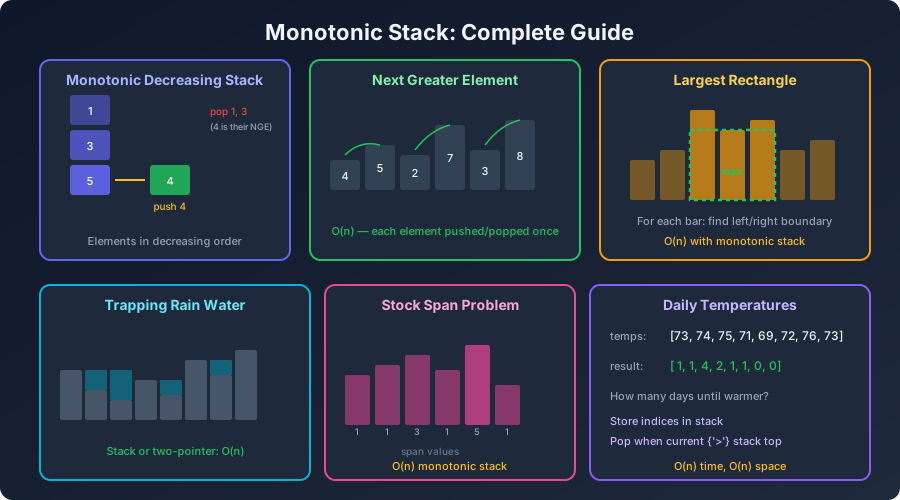
A monotonic stack is a stack where elements are maintained in either strictly increasing or strictly decreasing order. When a new element arrives that would violate the order, we pop elements until the invariant is restored.
Key Insight: Amortised O(n)
Each element is pushed once and popped at most once. Even though we have nested loops, the total work across all iterations is O(n).
Two Flavours
| Type | Elements in stack | What gets popped | Use case |
|---|---|---|---|
| Decreasing | Top is smallest | Smaller elements are popped by larger incoming | Next Greater Element |
| Increasing | Top is largest | Larger elements are popped by smaller incoming | Next Smaller Element |
1. Next Greater Element
Problem: For each element, find the first element to its right that is greater. (LeetCode 496, 503)
The Algorithm
Use a monotonic decreasing stack (top is smallest). When a new element is larger than the top, the top has found its next greater element.
def next_greater_element(nums):
    n = len(nums)
    result = [-1] * n
    stack = []  # stores indices

    for i in range(n):
        while stack and nums[i] > nums[stack[-1]]:
            idx = stack.pop()
            result[idx] = nums[i]
        stack.append(i)

    return result
Time: O(n) | Space: O(n)
Circular Array Variant (LeetCode 503)
Process the array twice (or use modular indexing):
def next_greater_circular(nums):
    n = len(nums)
    result = [-1] * n
    stack = []

    for i in range(2 * n):
        idx = i % n
        while stack and nums[idx] > nums[stack[-1]]:
            result[stack.pop()] = nums[idx]
        if i < n:
            stack.append(i)

    return result
2. Next Smaller Element
Same idea but use a monotonic increasing stack:
def next_smaller_element(nums):
    n = len(nums)
    result = [-1] * n
    stack = []

    for i in range(n):
        while stack and nums[i] < nums[stack[-1]]:
            idx = stack.pop()
            result[idx] = nums[i]
        stack.append(i)

    return result
Previous Greater / Previous Smaller
Scan from right to left instead:
def previous_smaller_element(nums):
    n = len(nums)
    result = [-1] * n
    stack = []

    for i in range(n):
        while stack and nums[stack[-1]] >= nums[i]:
            stack.pop()
        if stack:
            result[i] = nums[stack[-1]]
        stack.append(i)

    return result
3. Largest Rectangle in Histogram
Problem: Given an array of bar heights, find the area of the largest rectangle. (LeetCode 84)
The Insight
For each bar, the largest rectangle using that bar as the shortest bar extends left and right until a shorter bar is found. This is exactly “previous smaller” and “next smaller.”
def largest_rectangle_area(heights):
    n = len(heights)
    stack = []
    max_area = 0

    for i in range(n + 1):
        h = heights[i] if i < n else 0  # sentinel

        while stack and h < heights[stack[-1]]:
            height = heights[stack.pop()]
            width = i if not stack else i - stack[-1] - 1
            max_area = max(max_area, height * width)

        stack.append(i)

    return max_area
Time: O(n) | Space: O(n)
Step-by-Step Walkthrough
For heights = [2, 1, 5, 6, 2, 3]:
| i | h | Stack action | Area calculated |
|---|---|---|---|
| 0 | 2 | Push 0 | - |
| 1 | 1 | Pop 0: height=2, width=1, area=2. Push 1 | 2 |
| 2 | 5 | Push 2 | - |
| 3 | 6 | Push 3 | - |
| 4 | 2 | Pop 3: h=6, w=1, a=6. Pop 2: h=5, w=2, a=10. Push 4 | 10 |
| 5 | 3 | Push 5 | - |
| 6 | 0 | Pop 5: h=3, w=1, a=3. Pop 4: h=2, w=4, a=8. Pop 1: h=1, w=6, a=6 | 10 |
Answer: 10 (bars at index 2-3 with height 5).
Two-Pass Alternative
def largest_rectangle_two_pass(heights):
    n = len(heights)
    left = [0] * n   # index of previous smaller
    right = [0] * n   # index of next smaller

    # Previous smaller
    stack = []
    for i in range(n):
        while stack and heights[stack[-1]] >= heights[i]:
            stack.pop()
        left[i] = stack[-1] if stack else -1
        stack.append(i)

    # Next smaller
    stack = []
    for i in range(n - 1, -1, -1):
        while stack and heights[stack[-1]] >= heights[i]:
            stack.pop()
        right[i] = stack[-1] if stack else n
        stack.append(i)

    max_area = 0
    for i in range(n):
        max_area = max(max_area, heights[i] * (right[i] - left[i] - 1))

    return max_area
4. Maximal Rectangle in Binary Matrix
Problem: Given a binary matrix, find the largest rectangle containing only 1s. (LeetCode 85)
Reduction to Histogram
For each row, build a histogram of consecutive 1s in each column. Then apply “largest rectangle in histogram.”
def maximal_rectangle(matrix):
    if not matrix:
        return 0

    m, n = len(matrix), len(matrix[0])
    heights = [0] * n
    max_area = 0

    for i in range(m):
        for j in range(n):
            heights[j] = heights[j] + 1 if matrix[i][j] == '1' else 0

        max_area = max(max_area, largest_rectangle_area(heights))

    return max_area
Time: O(m * n) | Space: O(n)
5. Trapping Rain Water
Problem: Given elevation bars, compute how much rain water can be trapped. (LeetCode 42)
Approach 1: Monotonic Stack
Use a monotonic decreasing stack. When a taller bar arrives, water can be trapped between it and the previous taller bar.
def trap_stack(height):
    stack = []
    water = 0

    for i, h in enumerate(height):
        while stack and h > height[stack[-1]]:
            bottom = height[stack.pop()]
            if not stack:
                break
            width = i - stack[-1] - 1
            bounded_height = min(h, height[stack[-1]]) - bottom
            water += width * bounded_height

        stack.append(i)

    return water
Time: O(n) | Space: O(n)
Approach 2: Two Pointers (Optimal Space)
def trap_two_pointers(height):
    left, right = 0, len(height) - 1
    left_max = right_max = 0
    water = 0

    while left < right:
        if height[left] < height[right]:
            if height[left] >= left_max:
                left_max = height[left]
            else:
                water += left_max - height[left]
            left += 1
        else:
            if height[right] >= right_max:
                right_max = height[right]
            else:
                water += right_max - height[right]
            right -= 1

    return water
Time: O(n) | Space: O(1)
Approach 3: Prefix Max Arrays
def trap_prefix(height):
    n = len(height)
    if n <= 2:
        return 0

    left_max = [0] * n
    right_max = [0] * n

    left_max[0] = height[0]
    for i in range(1, n):
        left_max[i] = max(left_max[i - 1], height[i])

    right_max[n - 1] = height[n - 1]
    for i in range(n - 2, -1, -1):
        right_max[i] = max(right_max[i + 1], height[i])

    water = 0
    for i in range(n):
        water += min(left_max[i], right_max[i]) - height[i]

    return water
Time: O(n) | Space: O(n)
6. Stock Span Problem
Problem: For each day, find how many consecutive previous days (including today) have a price less than or equal to today’s price. (LeetCode 901)
class StockSpanner:
    def __init__(self):
        self.stack = []  # (price, span)

    def next(self, price):
        span = 1
        while self.stack and self.stack[-1][0] <= price:
            span += self.stack.pop()[1]
        self.stack.append((price, span))
        return span
Time: O(1) amortised per call | Space: O(n)
7. Daily Temperatures
Problem: Given daily temperatures, for each day find how many days until a warmer temperature. Return 0 if no warmer day exists. (LeetCode 739)
def daily_temperatures(temperatures):
    n = len(temperatures)
    result = [0] * n
    stack = []  # indices

    for i in range(n):
        while stack and temperatures[i] > temperatures[stack[-1]]:
            idx = stack.pop()
            result[idx] = i - idx
        stack.append(i)

    return result
Time: O(n) | Space: O(n)
Choosing the Right Stack Type
| I need to find… | Stack type | Pop condition |
|---|---|---|
| Next Greater Element | Decreasing | incoming > top |
| Next Smaller Element | Increasing | incoming < top |
| Previous Greater Element | Decreasing (scan L-R) | incoming >= top |
| Previous Smaller Element | Increasing (scan L-R) | incoming <= top |
Template
def monotonic_stack_template(nums):
    n = len(nums)
    result = [-1] * n
    stack = []

    for i in range(n):
        # For "next greater": while stack and nums[i] > nums[stack[-1]]
        # For "next smaller": while stack and nums[i] < nums[stack[-1]]
        while stack and CONDITION(nums[i], nums[stack[-1]]):
            idx = stack.pop()
            result[idx] = i  # or nums[i], depending on what you need
        stack.append(i)

    return result
Common Mistakes
- Forgetting the sentinel. In histogram, appending a 0 at the end ensures all bars are processed.
- Strict vs. non-strict comparison. For “next greater,” use
>. For “next greater or equal,” use>=. This affects whether equal elements pop each other. - Storing values vs. indices. Always store indices. You can look up the value from the index, but not the other way around.
- Trapping rain water: computing height wrong. The bounded height is
min(left, right) - bottom, notmin(left, right) - 0. - Off-by-one in width calculation. Width is
i - stack[-1] - 1, noti - stack[-1].
Big-O Summary
| Problem | Time | Space |
|---|---|---|
| Next Greater/Smaller | O(n) | O(n) |
| Largest Rectangle | O(n) | O(n) |
| Maximal Rectangle | O(m*n) | O(n) |
| Trapping Rain Water | O(n) | O(1) with two pointers |
| Stock Span | O(1) amortised | O(n) |
| Daily Temperatures | O(n) | O(n) |
Practice Problems
| Problem | Platform | Difficulty |
|---|---|---|
| Next Greater Element I | LeetCode 496 | Easy |
| Next Greater Element II | LeetCode 503 | Medium |
| Largest Rectangle in Histogram | LeetCode 84 | Hard |
| Maximal Rectangle | LeetCode 85 | Hard |
| Trapping Rain Water | LeetCode 42 | Hard |
| Online Stock Span | LeetCode 901 | Medium |
| Daily Temperatures | LeetCode 739 | Medium |
| Sum of Subarray Minimums | LeetCode 907 | Medium |
| 132 Pattern | LeetCode 456 | Medium |
| Remove K Digits | LeetCode 402 | Medium |
Related articles
- DSA Next Greater Element II — Circular Array with Monotonic Stack (LeetCode 503)
Next Greater Element II solved with monotonic stack and circular array double-length trick. Python solution with step-by-step trace, complexity analysis, and patterns.
- DSA Stack and Queue Interview Patterns — 15+ Patterns Catalog
Comprehensive catalog of 15+ stack and queue interview patterns with when-to-use guide, Python templates, complexity analysis, and problem mapping for coding interviews.
- DSA Knapsack DP Variants: 0/1, Unbounded, Fractional, Subset Sum & Target Sum
Master every knapsack variant — 0/1 knapsack, unbounded knapsack, fractional knapsack, subset sum, partition equal subset, and target sum with Python solutions and Big-O analysis.
- DSA Longest Subsequence Variants: LIS, Bitonic, Chain, Zigzag & Envelopes
Master longest subsequence problems — LIS with patience sorting, longest bitonic, chain of pairs, zigzag subsequence, Russian doll envelopes (2D LIS).