LRU Cache Design: HashMap + Doubly Linked List
Design and implement an LRU Cache from scratch using a HashMap and Doubly Linked List for O(1) get and put, with Python code, OrderedDict shortcut, and real-world context.
What you'll learn
- ✓What LRU (Least Recently Used) eviction means
- ✓Why you need both a HashMap and a Doubly Linked List
- ✓Full implementation from scratch in Python
- ✓The OrderedDict shortcut for Python interviews
- ✓Time complexity proof for O(1) get and put
- ✓Real-world usage in Redis, browser caches, and OS page replacement
- ✓How LRU compares to LFU caching
Prerequisites
- •Doubly linked lists — see Doubly Linked Lists
- •Hash maps — see Hash Maps Intro
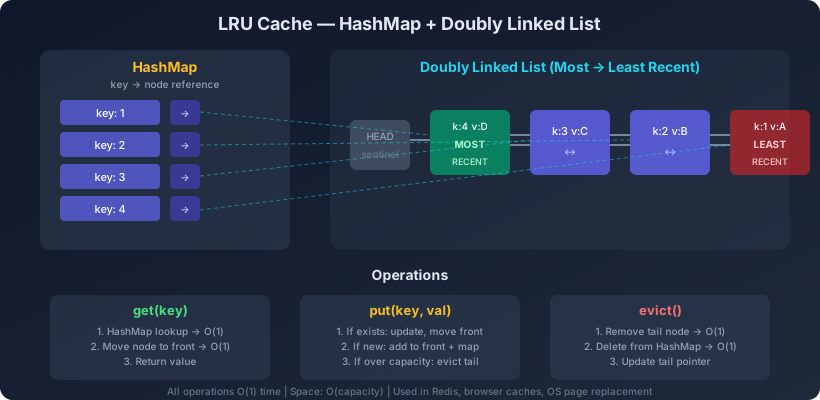
The LRU Cache is one of the most frequently asked system design and coding interview questions. It tests your ability to combine two data structures for optimal performance. Let’s understand why it works and build one from scratch.
What is an LRU Cache?
An LRU (Least Recently Used) Cache is a fixed-size key-value store that evicts the least recently accessed item when it reaches capacity.
Rules:
get(key)— Return the value if the key exists, and mark it as recently used. Return -1 if not found.put(key, value)— Insert or update the key-value pair. If the cache is full, evict the least recently used item first.- Both operations must be O(1) time.
Why HashMap + Doubly Linked List?
No single data structure gives us O(1) for all operations:
| Data Structure | Lookup | Insert/Delete | Track Order |
|---|---|---|---|
| Array | O(1) index, O(n) value | O(n) | Need shifting |
| HashMap | O(1) | O(1) | No order |
| Linked List | O(n) | O(1) with ref | Maintains order |
| HashMap + DLL | O(1) | O(1) | O(1) |
The combination works because:
- HashMap gives O(1) lookup by key, pointing to the DLL node
- Doubly Linked List maintains access order — most recent at head, least recent at tail
- DLL nodes can be removed in O(1) when you have a direct reference (via the HashMap)
Implementation from Scratch
Step 1: The DLL Node
class DLLNode:
    """Node for the doubly linked list."""
    __slots__ = ['key', 'val', 'prev', 'next']

    def __init__(self, key=0, val=0):
        self.key = key
        self.val = val
        self.prev = None
        self.next = None
Using __slots__ reduces memory overhead per node.
Step 2: The LRU Cache
class LRUCache:
    def __init__(self, capacity: int):
        self.capacity = capacity
        self.cache = {}  # key -> DLLNode

        # Sentinel nodes eliminate edge cases
        self.head = DLLNode()  # Dummy head (most recent side)
        self.tail = DLLNode()  # Dummy tail (least recent side)
        self.head.next = self.tail
        self.tail.prev = self.head

    # ---------- Internal DLL operations ----------

    def _add_to_front(self, node):
        """Add node right after head (most recent position)."""
        node.prev = self.head
        node.next = self.head.next
        self.head.next.prev = node
        self.head.next = node

    def _remove_node(self, node):
        """Remove a node from the DLL. O(1)."""
        node.prev.next = node.next
        node.next.prev = node.prev

    def _move_to_front(self, node):
        """Mark node as most recently used."""
        self._remove_node(node)
        self._add_to_front(node)

    def _evict_lru(self):
        """Remove the least recently used node (just before tail)."""
        lru_node = self.tail.prev
        self._remove_node(lru_node)
        del self.cache[lru_node.key]

    # ---------- Public API ----------

    def get(self, key: int) -> int:
        """
        Get value by key. Returns -1 if not found.
        Time: O(1)
        """
        if key not in self.cache:
            return -1

        node = self.cache[key]
        self._move_to_front(node)  # Mark as recently used
        return node.val

    def put(self, key: int, value: int) -> None:
        """
        Insert or update a key-value pair.
        Evicts LRU item if at capacity.
        Time: O(1)
        """
        if key in self.cache:
            # Update existing
            node = self.cache[key]
            node.val = value
            self._move_to_front(node)
        else:
            # Insert new
            if len(self.cache) >= self.capacity:
                self._evict_lru()

            new_node = DLLNode(key, value)
            self.cache[key] = new_node
            self._add_to_front(new_node)

    def __repr__(self):
        items = []
        node = self.head.next
        while node is not self.tail:
            items.append(f"{node.key}:{node.val}")
            node = node.next
        return f"LRU([{', '.join(items)}])"
Step 3: Testing
cache = LRUCache(3)

cache.put(1, 'A')
cache.put(2, 'B')
cache.put(3, 'C')
print(cache)  # LRU([3:C, 2:B, 1:A])

cache.get(1)  # Access key 1 — moves to front
print(cache)  # LRU([1:A, 3:C, 2:B])

cache.put(4, 'D')  # Capacity full — evicts key 2 (LRU)
print(cache)  # LRU([4:D, 1:A, 3:C])

print(cache.get(2))  # -1 (evicted)
print(cache.get(3))  # C (moves to front)
print(cache)  # LRU([3:C, 4:D, 1:A])

cache.put(5, 'E')  # Evicts key 1
print(cache)  # LRU([5:E, 3:C, 4:D])
Why sentinels?
Without sentinel nodes, _add_to_front and _remove_node need to check if the node is the head or tail:
# WITHOUT sentinels — many edge cases:
def _remove_node(self, node):
    if node.prev:
        node.prev.next = node.next
    else:
        self.head = node.next  # Was the head

    if node.next:
        node.next.prev = node.prev
    else:
        self.tail = node.prev  # Was the tail

# WITH sentinels — clean, no edge cases:
def _remove_node(self, node):
    node.prev.next = node.next
    node.next.prev = node.prev
The OrderedDict Shortcut
Python’s collections.OrderedDict maintains insertion order and supports move_to_end, making LRU trivial:
from collections import OrderedDict

class LRUCacheOrderedDict:
    def __init__(self, capacity: int):
        self.capacity = capacity
        self.cache = OrderedDict()

    def get(self, key: int) -> int:
        if key not in self.cache:
            return -1
        self.cache.move_to_end(key)  # Mark as recently used
        return self.cache[key]

    def put(self, key: int, value: int) -> None:
        if key in self.cache:
            self.cache.move_to_end(key)
        self.cache[key] = value
        if len(self.cache) > self.capacity:
            self.cache.popitem(last=False)  # Remove oldest (first)
This is acceptable in Python interviews, but interviewers usually want the full HashMap + DLL implementation to test your understanding.
Thread-Safe LRU Cache
In production, caches are accessed by multiple threads:
import threading

class ThreadSafeLRUCache:
    def __init__(self, capacity):
        self.cache = LRUCache(capacity)
        self.lock = threading.Lock()

    def get(self, key):
        with self.lock:
            return self.cache.get(key)

    def put(self, key, value):
        with self.lock:
            self.cache.put(key, value)
For high-concurrency systems, consider using a sharded cache (multiple LRU caches, one per shard) to reduce lock contention.
LRU vs LFU Cache
| Feature | LRU | LFU |
|---|---|---|
| Eviction criteria | Least recently used | Least frequently used |
| Tracks | Access order | Access count |
| Data structure | HashMap + DLL | HashMap + frequency buckets |
| Good for | Temporal locality | Long-term popularity |
| Drawback | One-time accesses stay | Old popular items linger |
# LFU evicts based on access count
# If key A was accessed 100 times an hour ago,
# and key B was accessed once just now:
# LRU evicts A (less recent)
# LFU evicts B (less frequent)
Real-World Usage
Redis
Redis uses an approximated LRU algorithm called allkeys-lru. Instead of maintaining an exact DLL, it samples random keys and evicts the one with the oldest access time. This is more memory-efficient for millions of keys.
Browser Cache
Browsers cache HTTP responses (HTML, CSS, JS, images). When the cache is full, the least recently accessed resources are evicted. This is why revisiting a page is fast but visiting many new sites slows things down.
Operating System Page Replacement
When RAM is full and a new page is needed, the OS evicts the least recently used page to disk. The LRU policy approximates optimal page replacement for most workloads.
CPU Cache
L1/L2/L3 CPU caches use LRU (or pseudo-LRU) to decide which cache line to evict. This is critical for performance — a cache miss to main memory is ~100x slower.
Complexity Analysis
| Operation | Time | Space |
|---|---|---|
get(key) | O(1) | - |
put(key, value) | O(1) | - |
| Space (total) | - | O(capacity) |
Why O(1)?
- HashMap lookup: O(1) average
- DLL add/remove/move: O(1) — just pointer changes
- No operation touches more than a constant number of nodes
LeetCode-Ready Implementation
Here is the exact implementation that passes LeetCode 146:
class LRUCache:
    def __init__(self, capacity: int):
        self.cap = capacity
        self.cache = {}
        self.head = DLLNode()
        self.tail = DLLNode()
        self.head.next = self.tail
        self.tail.prev = self.head

    def _remove(self, node):
        node.prev.next = node.next
        node.next.prev = node.prev

    def _insert(self, node):
        node.next = self.head.next
        node.prev = self.head
        self.head.next.prev = node
        self.head.next = node

    def get(self, key: int) -> int:
        if key in self.cache:
            node = self.cache[key]
            self._remove(node)
            self._insert(node)
            return node.val
        return -1

    def put(self, key: int, value: int) -> None:
        if key in self.cache:
            self._remove(self.cache[key])

        node = DLLNode(key, value)
        self.cache[key] = node
        self._insert(node)

        if len(self.cache) > self.cap:
            lru = self.tail.prev
            self._remove(lru)
            del self.cache[lru.key]
Practice Problems
- LeetCode 146 — LRU Cache: The classic problem (Medium)
- LeetCode 460 — LFU Cache: Least Frequently Used variant (Hard)
- LeetCode 1171 — Remove Zero Sum Consecutive Nodes: Uses OrderedDict (Medium)
- LeetCode 432 — All O’one Data Structure: HashMap + DLL for min/max (Hard)
- Design a TTL Cache: LRU with time-to-live expiration (System Design)
Key Takeaways
- An LRU Cache combines a HashMap (O(1) lookup) with a Doubly Linked List (O(1) ordered insertion/removal).
- Sentinel nodes eliminate all edge cases in the DLL operations.
- Python’s
OrderedDictprovides a shortcut, but interviewers expect the full implementation. - LRU is the most common eviction policy in practice — used in Redis, browsers, OS page replacement, and CPU caches.
- The key insight: storing
keyin the DLL node lets you delete from the HashMap when evicting.
Related articles
- DSA Design Front Middle Back Queue — Two Deques (LeetCode 1670)
Design Front Middle Back Queue using two balanced deques. Python solution with O(1) operations, step-by-step trace, and complexity analysis for LeetCode 1670.
- DSA Maximum Frequency Stack — HashMap + Stack Groups (LeetCode 895)
Maximum Frequency Stack solved with HashMap and stack groups by frequency. Python implementation with step-by-step trace, complexity analysis, and design insights.
- DSA Deque Design Patterns — Sliding Window, Palindrome, Work Stealing
Master deque design patterns including sliding window maximum, palindrome checking, work stealing, and BFS/DFS hybrid. Python implementations.
- DSA Priority Queue Patterns — Top-K, Merge K Lists, Median, Dijkstra
Master priority queue patterns for coding interviews. Top-K elements, merge K sorted lists, running median, and Dijkstra's algorithm in Python.