Heap Sort and Heap Construction: The Complete Guide
Understand heap sort, why build-heap is O(n) not O(n log n), sift-down vs sift-up, in-place sorting, partial sort for top K, and comparisons with other sorts.
What you'll learn
- ✓How heap sort works: build heap then extract
- ✓Why build-heap using sift-down is O(n) not O(n log n)
- ✓Sift-down vs sift-up: when to use each
- ✓In-place heap sort implementation in Python
- ✓Partial sort (top K) and comparison with other O(n log n) sorts
Prerequisites
- •Heaps: [Heaps and Priority Queues](/blog/heaps-priority-queues)
- •Arrays: [Arrays Introduction](/blog/arrays-introduction)
- •Big-O: [Big-O Notation Explained](/blog/big-o-notation-explained)
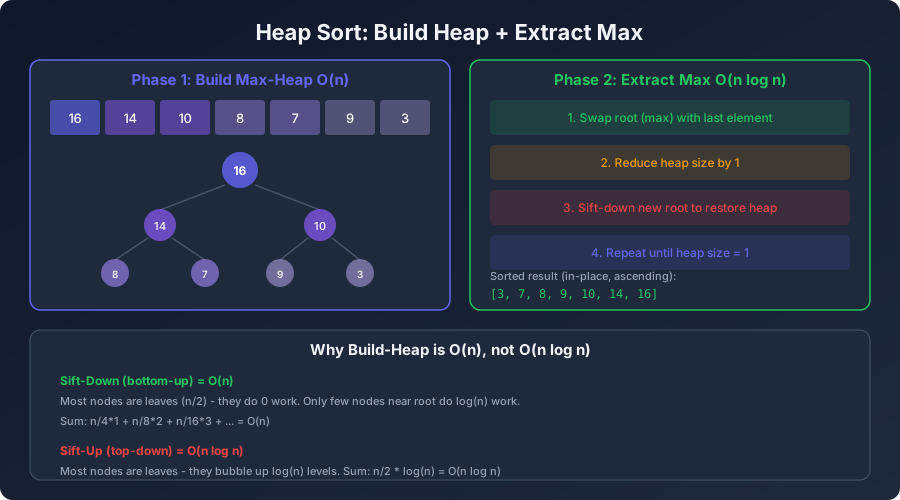
Heap sort is the only comparison-based sorting algorithm that is both O(n log n) worst-case and O(1) extra space. It combines the best properties of merge sort (guaranteed performance) and quicksort (in-place). Understanding heap construction deeply also unlocks efficient solutions for “top K” problems.
Heap recap
A max-heap is a complete binary tree stored as an array where every parent is greater than or equal to its children.
# For node at index i (0-indexed):
# Parent:       (i - 1) // 2
# Left child:   2 * i + 1
# Right child:  2 * i + 2
The root (index 0) always contains the maximum element.
The sift-down operation
Sift-down fixes a single violation where a node is smaller than one of its children by swapping it downward.
def sift_down(arr, n, i):
    """
    Restore heap property by sifting node i downward.
    n is the heap size (may be less than len(arr) during sort).

    Time: O(log n) worst case (height of tree)
    """
    largest = i
    left = 2 * i + 1
    right = 2 * i + 2

    if left < n and arr[left] > arr[largest]:
        largest = left

    if right < n and arr[right] > arr[largest]:
        largest = right

    if largest != i:
        arr[i], arr[largest] = arr[largest], arr[i]
        sift_down(arr, n, largest)  # Continue sifting down


# Iterative version (avoids recursion overhead)
def sift_down_iterative(arr, n, i):
    """
    Iterative sift-down. Same logic, no recursion stack.
    """
    while True:
        largest = i
        left = 2 * i + 1
        right = 2 * i + 2

        if left < n and arr[left] > arr[largest]:
            largest = left
        if right < n and arr[right] > arr[largest]:
            largest = right

        if largest == i:
            break

        arr[i], arr[largest] = arr[largest], arr[i]
        i = largest
The sift-up operation
Sift-up fixes a violation where a node is larger than its parent by swapping it upward. This is used when inserting a new element.
def sift_up(arr, i):
    """
    Restore heap property by sifting node i upward.
    Time: O(log n) worst case
    """
    while i > 0:
        parent = (i - 1) // 2
        if arr[i] > arr[parent]:
            arr[i], arr[parent] = arr[parent], arr[i]
            i = parent
        else:
            break
Building a heap: O(n) vs O(n log n)
There are two ways to build a heap from an unsorted array. They look similar but have dramatically different performance.
Method 1: sift-up (top-down) - O(n log n)
Insert elements one by one, sifting each up to its correct position.
def build_heap_sift_up(arr):
    """
    Build heap by inserting elements one by one.
    Time: O(n log n) - SLOWER
    """
    for i in range(1, len(arr)):
        sift_up(arr, i)
    return arr
Each of the n elements might need to travel up to log(n) levels. Roughly n/2 elements are leaves, and each could sift up log(n) levels. Total work: approximately (n/2) * log(n) = O(n log n).
Method 2: sift-down (bottom-up) - O(n)
Start from the last non-leaf node and sift each node down.
def build_heap_sift_down(arr):
    """
    Build heap using bottom-up sift-down.
    Time: O(n) - FASTER

    Start from the last non-leaf node and work backwards.
    Leaves (indices n//2 to n-1) are already valid 1-element heaps.
    """
    n = len(arr)
    # Last non-leaf node is at index (n // 2 - 1)
    for i in range(n // 2 - 1, -1, -1):
        sift_down(arr, n, i)
    return arr
Why build-heap with sift-down is O(n)
This is one of the most commonly asked “why” questions in DSA interviews.
In a complete binary tree with n nodes:
- n/2 nodes are leaves - they do 0 swaps (already heaps).
- n/4 nodes are at height 1 - they do at most 1 swap each.
- n/8 nodes are at height 2 - they do at most 2 swaps each.
- …
- 1 node (root) is at height log(n) - it does at most log(n) swaps.
Total work:
T(n) = sum over h from 0 to log(n) of: (n / 2^(h+1)) * h

T(n) = n/2 * sum over h from 0 to infinity of: h / 2^h

The sum h/2^h from h=0 to infinity = 2

T(n) = n/2 * 2 = n = O(n)
Intuition: Most nodes are near the bottom and do very little work. Only a few nodes near the top do significant work. The work decreases geometrically as you go up, and the geometric sum converges.
def demonstrate_build_heap_cost(n):
    """
    Show the actual swap counts per level.
    """
    import math
    height = int(math.log2(n))
    total_swaps = 0

    for h in range(height + 1):
        nodes_at_height = n // (2 ** (h + 1))
        swaps_per_node = h
        level_swaps = nodes_at_height * swaps_per_node
        total_swaps += level_swaps
        print(f"  Height {h}: {nodes_at_height} nodes x {swaps_per_node} swaps = {level_swaps}")

    print(f"  Total swaps: {total_swaps} (n = {n})")
    print(f"  Ratio swaps/n: {total_swaps / n:.3f}")


print("Build-heap cost breakdown:")
demonstrate_build_heap_cost(1024)
# Height 0: 512 nodes x 0 swaps = 0
# Height 1: 256 nodes x 1 swaps = 256
# ...
# Total swaps ~= n
Compare with sift-up: In sift-up, the n/2 leaves potentially sift up log(n) levels each. That is (n/2) * log(n) = O(n log n). The leaves do the most work, which is the opposite situation.
Heap sort algorithm
Heap sort has two phases:
- Build a max-heap from the array (O(n)).
- Extract the max repeatedly: swap root with last element, reduce heap size, sift down (O(n log n)).
def heap_sort(arr):
    """
    Sort array in ascending order using heap sort.
    Time: O(n log n) guaranteed
    Space: O(1) - in-place
    """
    n = len(arr)

    # Phase 1: Build max-heap - O(n)
    for i in range(n // 2 - 1, -1, -1):
        sift_down(arr, n, i)

    # Phase 2: Extract elements one by one - O(n log n)
    for i in range(n - 1, 0, -1):
        # Move current root (maximum) to the end
        arr[0], arr[i] = arr[i], arr[0]
        # Sift down on reduced heap
        sift_down(arr, i, 0)

    return arr


# Example
data = [12, 11, 13, 5, 6, 7, 3, 1, 9, 2]
print(f"Original: {data}")
heap_sort(data)
print(f"Sorted:   {data}")
# Original: [12, 11, 13, 5, 6, 7, 3, 1, 9, 2]
# Sorted:   [1, 2, 3, 5, 6, 7, 9, 11, 12, 13]
Visualizing heap sort
def heap_sort_verbose(arr):
    """
    Heap sort with step-by-step output.
    """
    n = len(arr)

    # Build max-heap
    for i in range(n // 2 - 1, -1, -1):
        sift_down(arr, n, i)
    print(f"Max-heap built: {arr}")

    # Extract
    for i in range(n - 1, 0, -1):
        print(f"  Swap root={arr[0]} with arr[{i}]={arr[i]}")
        arr[0], arr[i] = arr[i], arr[0]
        sift_down(arr, i, 0)
        print(f"  After sift-down: {arr[:i]} | sorted: {arr[i:]}")

    return arr


heap_sort_verbose([4, 10, 3, 5, 1])
Partial sort: finding top K elements
One of heap sort’s greatest strengths is partial sorting. If you only need the K largest (or smallest) elements, you can stop after K extractions.
def top_k_largest(arr, k):
    """
    Find the k largest elements using a max-heap.
    Time: O(n + k log n) - much better than full sort when k << n
    Space: O(1)
    """
    n = len(arr)

    # Build max-heap in O(n)
    for i in range(n // 2 - 1, -1, -1):
        sift_down(arr, n, i)

    # Extract k elements in O(k log n)
    result = []
    heap_size = n
    for _ in range(k):
        result.append(arr[0])
        arr[0] = arr[heap_size - 1]
        heap_size -= 1
        sift_down(arr, heap_size, 0)

    return result


data = [3, 1, 4, 1, 5, 9, 2, 6, 5, 3, 5]
print(f"Top 3: {top_k_largest(data[:], 3)}")
# Top 3: [9, 6, 5]
Using a min-heap for top K (memory-efficient for streams)
import heapq

def top_k_with_min_heap(arr, k):
    """
    Find k largest using a min-heap of size k.
    Time: O(n log k)
    Space: O(k) - great when n is huge (streaming data)
    """
    # Maintain a min-heap of size k
    # The heap always contains the k largest elements seen so far
    # The root (smallest in heap) is the k-th largest overall

    heap = arr[:k]
    heapq.heapify(heap)

    for num in arr[k:]:
        if num > heap[0]:
            heapq.heapreplace(heap, num)  # pop smallest, push new

    return sorted(heap, reverse=True)


data = [3, 1, 4, 1, 5, 9, 2, 6, 5, 3, 5]
print(f"Top 3: {top_k_with_min_heap(data, 3)}")
# Top 3: [9, 6, 5]
Kth largest element
def find_kth_largest(nums, k):
    """
    Find the kth largest element.

    Method 1: Build max-heap, extract k times.
    Time: O(n + k log n)
    """
    # Build max-heap
    n = len(nums)
    for i in range(n // 2 - 1, -1, -1):
        sift_down(nums, n, i)

    # Extract k-1 elements
    heap_size = n
    for _ in range(k - 1):
        nums[0] = nums[heap_size - 1]
        heap_size -= 1
        sift_down(nums, heap_size, 0)

    return nums[0]


def find_kth_largest_minheap(nums, k):
    """
    Method 2: Min-heap of size k.
    Time: O(n log k), Space: O(k)
    """
    heap = nums[:k]
    heapq.heapify(heap)

    for num in nums[k:]:
        if num > heap[0]:
            heapq.heapreplace(heap, num)

    return heap[0]


data = [3, 2, 1, 5, 6, 4]
print(f"2nd largest: {find_kth_largest(data[:], 2)}")       # 5
print(f"2nd largest: {find_kth_largest_minheap(data, 2)}")  # 5
Comparison with other O(n log n) sorts
| Property | Heap Sort | Merge Sort | Quick Sort |
|---|---|---|---|
| Time (worst) | O(n log n) | O(n log n) | O(n^2) |
| Time (average) | O(n log n) | O(n log n) | O(n log n) |
| Time (best) | O(n log n) | O(n log n) | O(n log n) |
| Space | O(1) | O(n) | O(log n) stack |
| Stable? | No | Yes | No (usually) |
| Cache friendly? | No | Yes | Yes |
| Adaptive? | No | Natural merge sort | Yes (pattern-defeating) |
| Partial sort | Excellent | Poor | Quick-select |
When to choose heap sort
- Guaranteed O(n log n) worst case with O(1) space.
- Partial sorting: when you only need top K elements.
- Embedded systems: when extra memory allocation is not allowed.
When to avoid heap sort
- Cache performance: heap sort jumps around the array (parent-child relationships), causing cache misses. Merge sort and quicksort access memory more sequentially.
- Stability: heap sort is not stable. Equal elements may change relative order.
- Practical speed: despite same asymptotic complexity, heap sort is typically 2-3x slower than quicksort in practice due to cache behavior.
Heap sort for descending order
For descending order, use a min-heap instead of a max-heap:
def sift_down_min(arr, n, i):
    """Sift-down for min-heap."""
    smallest = i
    left = 2 * i + 1
    right = 2 * i + 2

    if left < n and arr[left] < arr[smallest]:
        smallest = left
    if right < n and arr[right] < arr[smallest]:
        smallest = right

    if smallest != i:
        arr[i], arr[smallest] = arr[smallest], arr[i]
        sift_down_min(arr, n, smallest)


def heap_sort_descending(arr):
    """
    Sort in descending order using min-heap.
    """
    n = len(arr)
    for i in range(n // 2 - 1, -1, -1):
        sift_down_min(arr, n, i)

    for i in range(n - 1, 0, -1):
        arr[0], arr[i] = arr[i], arr[0]
        sift_down_min(arr, i, 0)

    return arr


data = [4, 10, 3, 5, 1]
print(heap_sort_descending(data))
# [10, 5, 4, 3, 1]
Using Python’s heapq module
Python’s heapq module provides a min-heap. For a max-heap, negate
the values.
import heapq

def heap_sort_pythonic(arr):
    """
    Heap sort using Python's heapq module.
    Note: this uses O(n) extra space (not in-place).
    """
    heapq.heapify(arr)  # O(n) in-place
    return [heapq.heappop(arr) for _ in range(len(arr))]


data = [4, 10, 3, 5, 1]
print(heap_sort_pythonic(data))  # [1, 3, 4, 5, 10]
Complexity summary
| Operation | Time | Notes |
|---|---|---|
| Build heap (sift-down) | O(n) | Bottom-up, optimal |
| Build heap (sift-up) | O(n log n) | Top-down, suboptimal |
| Heap sort total | O(n log n) | Build O(n) + extract O(n log n) |
| Insert (sift-up) | O(log n) | Single element |
| Extract max/min | O(log n) | Root removal + sift-down |
| Top K elements | O(n + k log n) | Build heap + k extractions |
| Top K with min-heap | O(n log k) | Streaming-friendly |
Practice problems
| Problem | Difficulty | Key Technique |
|---|---|---|
| Sort an Array (LC 912) | Medium | Full heap sort |
| Kth Largest Element (LC 215) | Medium | Partial sort or min-heap |
| Top K Frequent Elements (LC 347) | Medium | Min-heap of size k |
| Merge K Sorted Lists (LC 23) | Hard | Min-heap for merging |
| Find Median from Data Stream (LC 295) | Hard | Two heaps |
| Sort Colors (LC 75) | Medium | Not heap sort (use 3-way partition) |
| Last Stone Weight (LC 1046) | Easy | Max-heap simulation |
| K Closest Points to Origin (LC 973) | Medium | Max-heap of size k |
Key takeaways
- Build-heap with sift-down is O(n) because most nodes are near the bottom and do minimal work. Sift-up is O(n log n) because most nodes are near the bottom and must travel far up.
- Heap sort is the only comparison sort that is O(n log n) worst-case and O(1) space.
- In practice, heap sort is slower than quicksort and merge sort due to poor cache locality.
- Heap sort excels at partial sorting (top K problems).
- Python’s
heapq.heapify()uses the O(n) sift-down approach.
Related articles
- DSA BFS Pattern with Queues: Level-Order and Shortest Path
Master BFS using queues for tree level-order traversal and shortest path in unweighted graphs. Python implementations with detailed traces.
- DSA Design Circular Deque — Array-Based Implementation (LeetCode 641)
Design a Circular Deque with front/rear pointers on a fixed-size array. Python solution with all O(1) operations, visual trace, and edge case handling.
- DSA Design Hit Counter Using Queue
Design a hit counter that counts hits in the past 5 minutes using a queue. LeetCode 362 solution with O(1) amortized operations.
- DSA First Non-Repeating Character in a Stream
Find the first non-repeating character in a character stream using a queue and hash map. Python solution with O(1) amortized per query.